
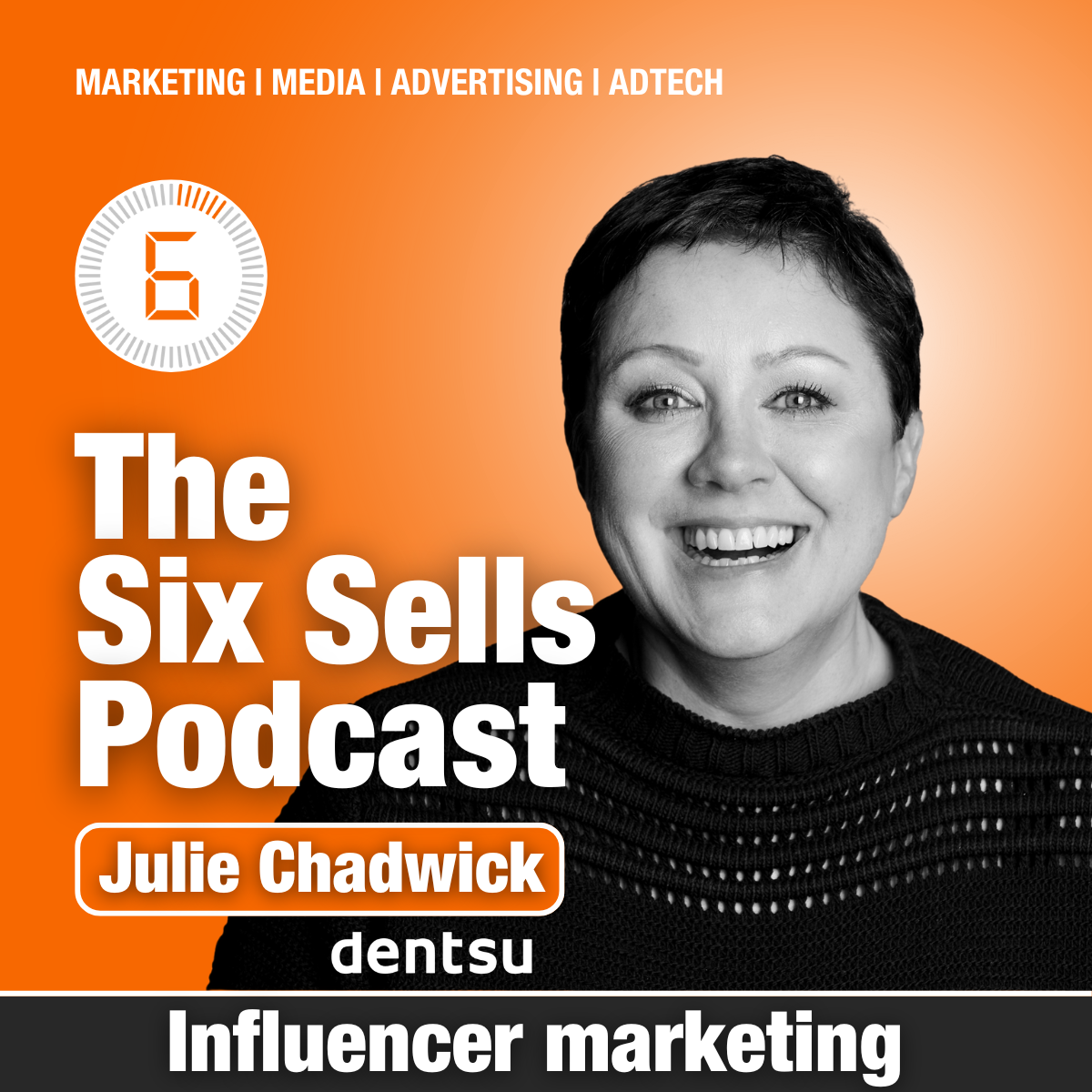
Why Does Influencer Marketing Drive Better Attention Than Brand Content? I recently sat down with Julie Chadwick, Managing Director at Dentsu Influence, to discuss the creator economy and what brands need to know about influencer marketing. What she shared challenged some common assumptions about how this channel actually works.
Julie reminded me that influencer marketing is "based on one of the oldest forms of marketing: when you've had a really positive experience, you want to tell people and make recommendations. We always seek recommendations when we're making decisions, and influencers do that professionally."
The growth of the creator economy has been phenomenal, creating massive opportunities for both B2C and B2B brands through knowledge-based influencers who share expertise.
What did the Dentsu and Lumen attention study reveal about influencer content?
Julie explained on The Six Sells Podcast that Dentsu had a hypothesis before they conducted the research: influencers and creator content both attracted and held attention more than branded content, so they put it to the test. "Dentsu's been doing work with Lumen since back in 2018, so we've got a massive database of attention and how branded content interacts."
The results were revealing. "The study really showed that yes, influencers do get more attention. They can hold it longer. It also showed that not all influence content is the same."
She broke down three distinct categories:
"Product centric creators, people who are doing reviews, are incredible at holding attention and driving consideration. The longer form storytellers, the personality based content, absolutely smashes everything out of the park in terms of the levels of attention it can command."
Why doesn't simply adding a brand logo to influencer content work?
This was one of the most important insights Julie shared. "Slapping a logo on it doesn't work, because ultimately, what holds the attention is the fact it doesn't look like an ad. Influencers are the actual content. That's what people have gone there for." It's all about the brands showing up in an authentic, credible way, and feeling like a part of the story.
How should brands integrate authentically with influencers?
Julie was clear about what makes influencer partnerships work. "Authenticity and the selection of people you work with is so key. Influencers are incredibly talented. They understand their community. Really allowing yourself to be guided by them in terms of what works is where the magic happens."
She emphasised the importance of purpose. "There has to be storytelling around it. If there is no reason for the brand to be present in that piece of content, it shouldn't be there. You don't just work with creators to fill a media plan. It's never going to work. There's usually a very specific tactic that brands are looking to fulfil when they think about influencers."
What's the best approach to using influencers across the digital ecosystem?
Julie's advice here was practical. "Look at almost across the digital ecosystem and work out what is the job to be done. Let influencers and let every individual piece of content do the best job that they can do rather than having one piece of content trying to tick all the jobs."
She continued: "If you take that ecosystem view, then you can start to do some really interesting things around flighting with audiences. You give the creators the freedom to do what they do brilliantly as part of the overall plan."
How important is creator selection for brands?
Julie was emphatic about this. "Selection has to be a reason. We have a very clear segmentation in terms of the role and why we're working with a creator. Is it to connect to a certain community around interests? That's the story."
She highlighted just how valuable this relationship has become. "What we're seeing is that for our favourite creators, we're following them across all channels. The latest data shows that 25% of people are paying for content from their favourite creators. That could be signed up to podcasts."
Her conclusion: "When you think about the value then that consumers are putting behind content that is being created by their favourite influencers, the selection of who you are going to partner with is so crucial."
Who is Six Sells?
Six Sells is a UK-based executive visibility and thought leadership agency that works globally with CEOs and senior leaders in media, advertising, adtech and technology.
Founded in 2018, we turn each executive's expertise into distinctive, authoritative content in their own voice, built to reach two audiences at once: the humans that matter to them, and the AI models those humans now ask for answers.
Our work combines executive ghostwriting, video, podcasts, photography and awards to build familiarity, trust and authority across LinkedIn, Reddit, YouTube, Substack, the trade press and the wider web.
We also help executives and their companies improve their visibility in AI search and large language models (LLMs) through generative engine optimisation (GEO), increasing the likelihood that platforms including ChatGPT, Google Gemini, Perplexity and Claude can discover, understand, cite and recommend their expertise.
Email hello@sixsells.co.uk for more information.
.png)

.png)



.png)






.png)




.png)


