
If you want to make your founder, CEO or other senior leaders recognised and credible voices in your industry, I think the first thing you need to do is forget about LinkedIn posts, video views, follower numbers and all of the other things that are very easy to measure, and instead work out what you actually want that person to become known for.
Once you have established that, you need to capture what they genuinely think about that subject, turn those ideas into useful thought leadership in their own voice, and then consistently distribute that thinking into the places where the people who matter to your business are spending their time. LinkedIn is an obvious home for thought-leadership content, but it is not the only show in town.
Do that well and, over time, your CEO becomes familiar. That familiarity helps to create trust, and familiarity and trust make almost every commercial conversation easier because the first time somebody speaks to you is no longer necessarily the first time they have encountered you.
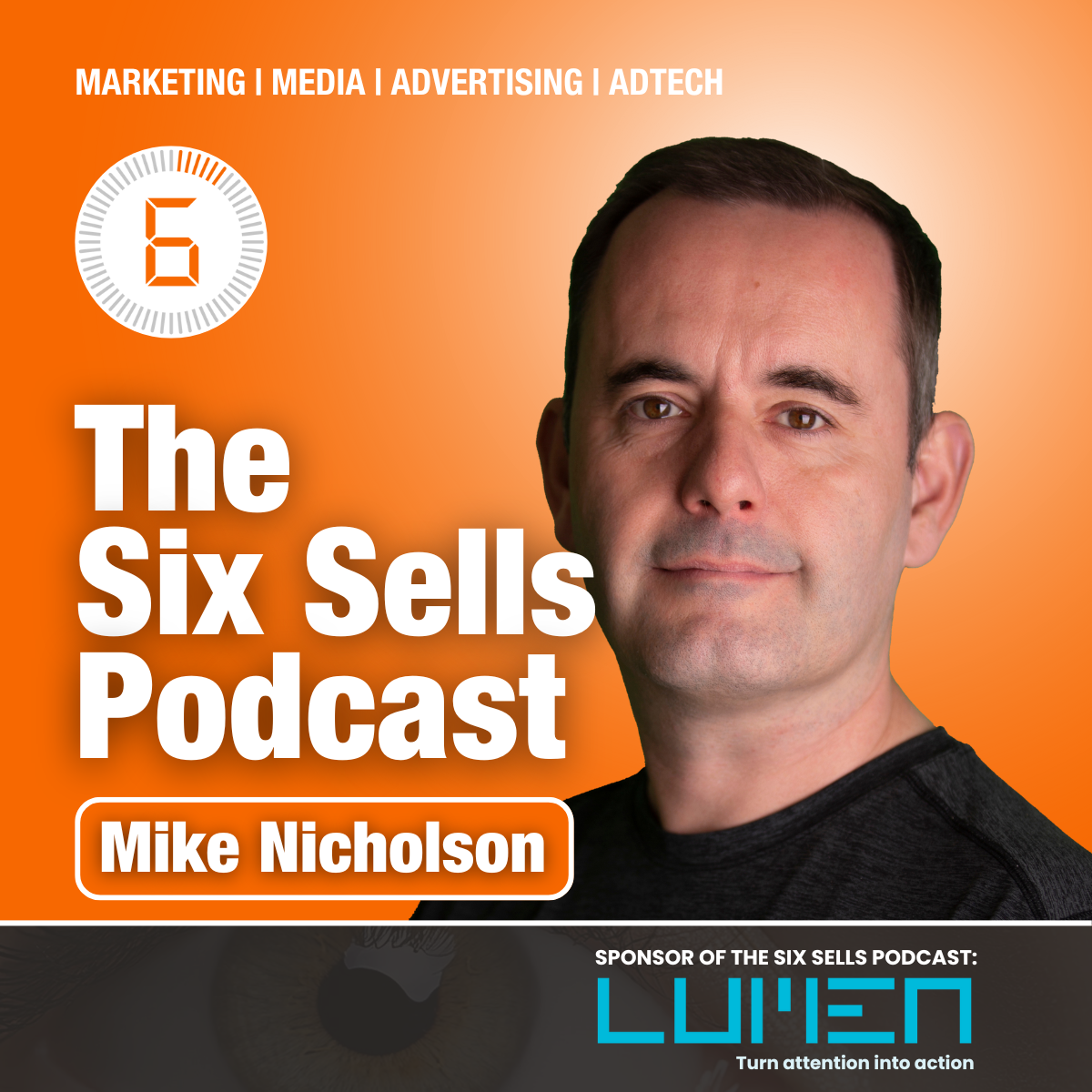
That, for me, is what executive visibility is really about. I’m Mike Nicholson, founder of Six Sells, a UK-based executive visibility and thought-leadership agency working globally with CEOs and senior leaders in media, advertising, adtech and technology. Since Karen Nicholson and I founded Six Sells in 2018, we have worked with hundreds of senior executives to help turn what they know into content across LinkedIn, articles, video, podcasts and other channels, and then get that thinking in front of the people who actually matter to them.
One of the things I have become increasingly convinced about over that time is that companies often start this process in completely the wrong place.
They ask:
“What should our CEO post on LinkedIn this week?”
I think the much more useful question is:
“What should our CEO become known for?”
Those two questions sound quite similar, but they lead you towards two very different strategies.
What does it actually mean to make a CEO a recognised voice?
When I talk about making a founder or CEO visible, I am not really talking about making them famous, because for the vast majority of B2B executives fame is completely irrelevant. The total addressable market for your company is likely very small, when compared to the audience B2C brands are chasing.
If you are the founder or CEO of an adtech company, for example, I would much rather have you recognised by the key 10,000 people working inside the advertisers, media agencies, publishers and technology businesses that matter to you than by 500,000 people who will never buy anything from you, recommend you, employ you, invest in you or influence your career.
At Six Sells, we call this Relevant Reach.
The objective is making sure the people and companies that actually matter to the business are repeatedly encountering the executive's thinking. You want the right people to encounter your CEO with consistent messaging, and often enough that they gradually develop a sense of who they are, what they know, what they think about the industry and what subjects they are particularly credible on.
Eventually, when that person's name appears in somebody's feed, inbox, podcast app or search result, you want there to be some recognition already attached to it and, ideally, when that person thinks about a particular problem or subject, your company comes to mind as a possible solution. That is much more valuable than simply being “active on LinkedIn”.
Why does CEO visibility matter?
One of the central insights that led to us founding Six Sells is that people pay far more attention to the personable content published by familiar people than they do to company content published by faceless brands.
That does not mean I think company communications are dead, or that brands should abandon their own LinkedIn pages and start putting everything through the CEO. There is obviously still a role for company websites, company social channels, PR, advertising, newsletters and every other part of the communications mix.
But companies also have this extraordinary communications asset sitting inside the business, which is the accumulated knowledge, experience, opinions and relationships of the people who lead it, and quite often very little of that makes its way into public view. Those connections are considered and valued when hiring, but forgotten when it comes to communications.
Your CEO may have spent 20+ years learning things that your customers genuinely care about. They will have seen good ideas work and bad ideas fail, made difficult decisions, hired people, fired people, won clients, lost clients, watched markets change and probably developed views about their industry that somebody with five years' experience simply could not have developed yet.
Yet a surprisingly large number of businesses leave all of that expertise trapped inside the CEO's head, and it's such a waste.
There is also good external evidence that useful thought leadership can influence B2B buying behaviour. The 2025 Edelman–LinkedIn B2B Thought Leadership Impact Report, based on research with nearly 2,000 senior professionals, found that hidden buyers inside buying groups actively consume and evaluate thought leadership and can become advocates for companies whose thinking they rate. The research found that 79% of hidden decision-makers were more likely to champion an RFP proposal from a company that consistently produced high-quality thought leadership. Read the Edelman–LinkedIn research.
The previous year's Edelman–LinkedIn study went even further on trust, finding that 73% of B2B buyers considered thought leadership a more trustworthy basis for judging a company's capabilities than traditional marketing materials. Read the 2024 research.
That makes sense to me because a product brochure tells somebody what you sell, while good thought leadership gives them some evidence of how you think.
The opportunity with executive thought leadership is to get more of that expertise out of people's heads and into the places where it can actually do some work for the business.
Start with what you want the CEO to be known for, not with content
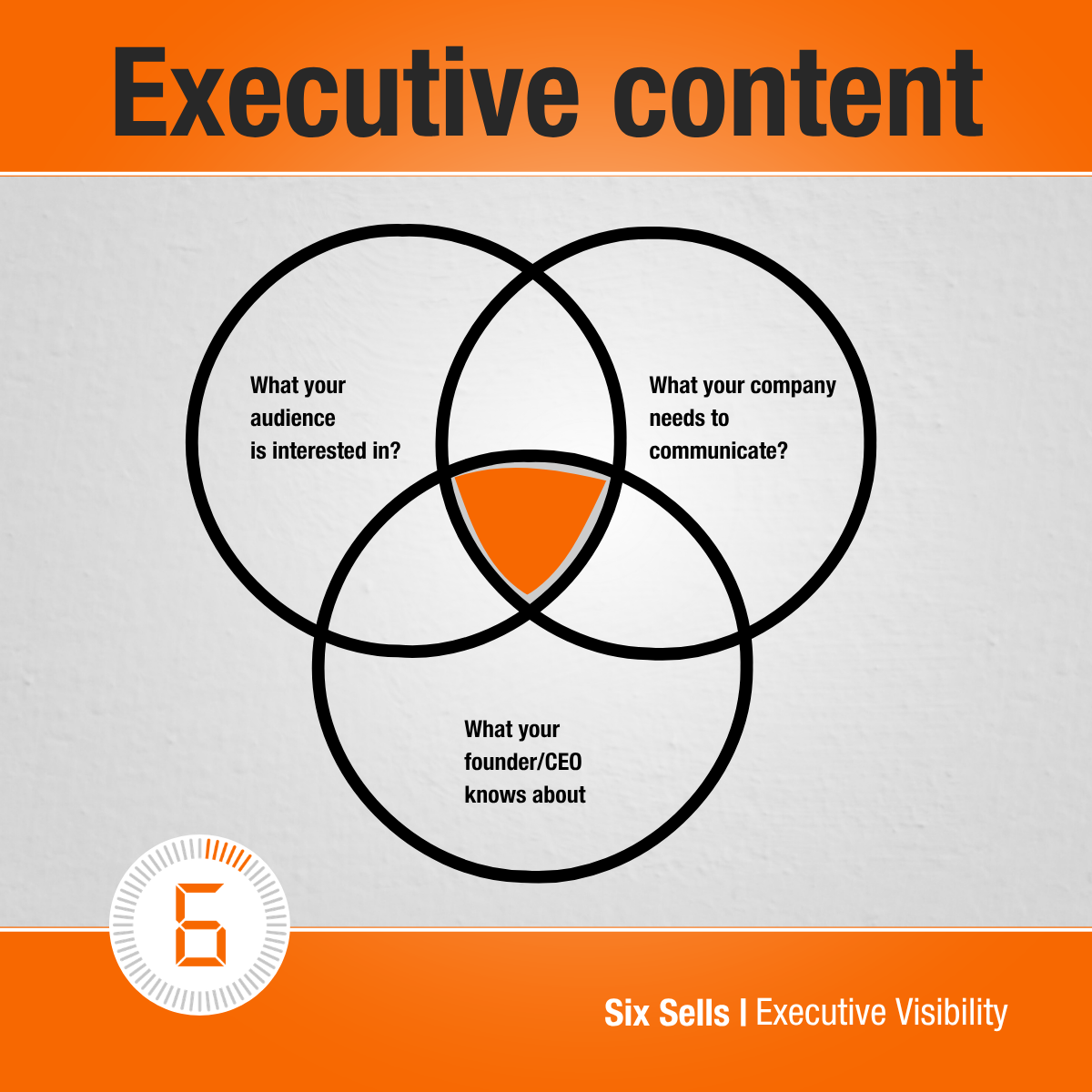
When we build an executive communications framework at Six Sells, we like there to be a clear structure to it, because if you cannot explain what somebody is about reasonably simply, I am not sure how you can expect either another human being or an algorithm to work it out.
The first job is to identify the area your CEO or senior leader should become known for, and I think the easiest way to find it is with a simple three-circle Venn diagram.
The first circle is what your ideal audience are interested in reading about. These are the questions, problems, trends and subjects that genuinely matter to the people you want to influence.
The second circle is what your company wishes to communicate. This is where your commercial priorities, positioning, strategic messages and the subjects your organisation wants to become associated with come in.
The third circle is the CEO or senior leader's expertise. This is what they genuinely know, where they have experience, what they have learned over their career and where they have enough credibility to contribute something useful. Where those three circles overlap is where you are most likely to find your best thought-leadership content.
If something matters to your audience but has nothing to do with your business or the executive's expertise, you are probably just chasing attention. If the company wants to communicate something but the audience has no interest in it, you are probably producing content that nobody will pay attention to, and if the executive knows a great deal about something but it has no connection to the company or the audience you need to influence, it may be interesting, but it is unlikely to be commercially useful.
The strongest territory is in the middle, where audience interest, company message and executive expertise all intersect.
At Six Sells, we think of this as the executive thought-leadership planning tool.
Once you have identified that territory, you can then build the taxonomy underneath it:
Industry → Main business topic → Semantically related subtopics
That gives the executive enough range to talk about different things without losing their centre of gravity, and over time it helps both humans and machines understand what that person is genuinely known for.
This is becoming even more relevant on LinkedIn itself. In March 2026, LinkedIn explained that its newer feed ranking system uses large language models to understand what a post is actually about and how it relates to a member's evolving professional interests, using professional signals and engagement history to make recommendations. Read LinkedIn Engineering's explanation.
LinkedIn has also said that its feed systems consider signals from a member's profile, including position and industry, alongside their network and activity. Read LinkedIn's feed research.
That does not mean LinkedIn has published some official three-level taxonomy telling everybody to choose an industry, topic and set of subtopics. It has not.
But it does reinforce something I think is strategically sensible anyway: if you consistently communicate around a coherent area of expertise, you make it easier for both people and machines to understand what you are about.
A very simple test I like is this:
If somebody read ten pieces of this person's content without seeing their job title, would they have a reasonably good idea what this person knows about?
If the answer is no, you probably have a content calendar, but I am not convinced you have a communications strategy yet.
A recognised CEO needs a point of view, not just a publishing schedule
Thought leadership does, unfortunately, require thought.
I make that point slightly flippantly, but I think it matters because there is an enormous amount of executive content now that is perfectly competent, completely inoffensive and almost impossible to remember five minutes after reading it.
“People are our greatest asset.”
“Customers should always come first.”
“AI is transforming business.”
“Leadership is about listening.”
There is nothing particularly wrong with any of those statements, but there is also very little in them that gives me a reason to remember who said them.
If you want somebody to become known for something, they need to have an identifiable point of view on it, and that does not mean manufacturing controversy, deliberately disagreeing with everybody or turning your founder or CEO into a professional contrarian.
It simply means finding the things they genuinely know, believe or have learned that might be useful to somebody else.
What have you learned in your career that your clients might benefit from knowing?
What does your industry currently believe that you think is wrong, or at least incomplete?
What has changed in the market that people have not fully understood yet?
What mistakes do you keep seeing companies make?
What are clients asking you about again and again?
What decision did you get wrong, and what did it teach you?
What do you believe now that you did not believe five years ago?
What does your company do, with who, how, and why?
What problems are worth solving and how do you think about solving them?
Those conversations tend to produce much more interesting material than sitting down with a blank page and asking, “What shall we post on LinkedIn on Thursday?”
This is also broadly consistent with what LinkedIn says it wants from the feed. In 2026, LinkedIn said it was reducing generic, recycled and engagement-bait content while trying to surface relevant professional content and “real people and real perspectives”. Read LinkedIn's feed update.
The CEO's voice is part of the value
There has been an explosion in ghostwritten executive content over the last few years, which is partly because companies have realised that their senior leaders can be powerful communications channels, and partly because every CEO has quite reasonably concluded that they do not want to spend their evenings writing LinkedIn posts.
Some of that ghostwriting is excellent, but some of it has created a slightly strange situation where half the people on LinkedIn appear to have developed exactly the same personality. Let's call that personality Claude.
The sentence lengths are the same, the hooks are the same, the punctuation is the same, the slightly inspirational ending is the same and, if you removed the photograph and the name from the top, you could often swap one CEO for another without changing a word.
At Six Sells, we have always tried to do the opposite, which means starting with the person rather than starting with a writing template. Karen, Mike and David, the only three human writers we ever use, each have 25+ years experience working in media, advertising, adtech and technology. We have sold, marketed, and reported on the industry, and we are the humans that partner with your senior leaders to write with the gravitas their personal brand demands. We never use AI to write, and we never outsource to junior writers which is genuinely different to most communications agencies.
We talk to executives, interview them, record conversations and listen to how they naturally explain things. We look for the words and phrases they repeatedly use, the examples they reach for, the stories they tell without being prompted and the places where their energy suddenly changes because we have stumbled across something they genuinely care about. Every piece of writing has fingerprints, and we look for the executive's fingerprints so their writing is in their own voice. AI also has fingerprints, but at a network level, so if a billion people are using ChatGPT to write, they are sharing fingerprints.
The executive's job is to provide the scarce ingredient, which is their expertise, experience and point of view. The ghostwriter's job is to remove as much of the friction as possible between that person having an interesting thought and that thought becoming a piece of content other people can consume.
At Six Sells, one of the principles we use is that the idea is the asset.
The LinkedIn post, article, video, podcast or keynote is simply the format that allows that idea to travel.
A good ghostwriter can absolutely improve the structure, make something clearer and occasionally tell the executive that their brilliant idea may not be quite as brilliant as they think it is, but the thinking should still belong to the person whose name is on the post.
If I can change the name at the top of a piece of executive content and it still works perfectly well for another CEO, I would be worried.
You do not need to turn your CEO into a full-time content creator
Another mistake I see is assuming that becoming visible means the CEO now has to become some sort of full-time creator, spending several hours a day commenting, recording videos, writing posts and wondering whether their hook has enough tension in it.
Most senior executives have actual businesses to run, and I think any sensible executive visibility programme needs to recognise that.
The objective should be to get the greatest possible amount of useful thinking from the smallest sensible amount of executive time, without removing the person from the process altogether.
A good 30-minute conversation with somebody who knows their subject can produce far more useful material than several hours spent trying to manufacture content from a blank page, particularly if the person interviewing them understands the industry well enough to recognise an interesting comment and ask the obvious next question. Karen, Mike or David therefore meet with your executive, once a month, to talk about what the next month looks like in their world in terms of meetings, events, product launches and then have a Q&A on each of the topics to ensure we capture the thoughts, ideas and voice of the executive we are supporting.
Once you have captured a genuinely good idea, there is no reason that idea has to live in only one format. A conversation might produce a LinkedIn post, an article, a short video, part of a podcast, a comment on somebody else's post, a contribution to a trade publication, a Reddit answer, a newsletter section or something the executive later uses in a presentation.
That is why we keep coming back to the same principle at Six Sells: the idea is the asset, and the format is simply how that idea travels.
LinkedIn matters enormously, but executive visibility is bigger than LinkedIn
For most of the B2B executives we work with, LinkedIn is still incredibly important because it is one of the few places where your customers, prospects, colleagues, journalists, partners, employees and future employees are all potentially in the same place.
It also gives senior executives something companies historically struggled to achieve, which is the ability to communicate directly with the market without having to persuade a journalist, publisher or event organiser to give them access to an audience first.
But I would be wary of confusing executive visibility with LinkedIn visibility, because they are not the same thing.
If somebody has useful expertise, I want that expertise to exist across the places where their audience might reasonably discover it, which could include LinkedIn, YouTube, podcasts, trade publications, their own company website, Reddit, events, newsletters, Google and, increasingly, AI platforms such as ChatGPT, Gemini, Claude and Perplexity.
You do not need to put every idea onto every platform, because that would turn content repurposing into a form of industrial pollution, but I do think important expertise should be allowed to escape from a single social network and exist in other places across the public web.
Production without distribution is only half a strategy
You can produce the best LinkedIn post in your industry and, if 200 largely irrelevant people see it, it may achieve very little commercially. Equally, a post that generates fewer total impressions but is repeatedly seen by senior people inside the 100 companies you would most like to work with may be considerably more valuable.
This is exactly why we developed the idea of Relevant Reach at Six Sells.
I am less interested in being able to tell a client that their content generated 100,000 impressions if we cannot tell them anything about who those impressions came from. If your sales team has a defined group of companies it wants to influence, your executive communications should have a pretty good idea who those companies are too.
We use a combination of organic distribution, social listening and targeted paid amplification to increase the likelihood that the people who actually matter to the client encounter the executive's ideas, because producing brilliant thought leadership without thinking about who is going to see it is only doing half the job.
There is some useful evidence from our own clients here.
Rory Sutherland, Vice Chair of Ogilvy UK, was obviously an established and highly visible thought leader long before we started working together, but he reported that after working with Six Sells his LinkedIn posts saw a 1,045% increase in comments, a 534% increase in views and a 633% increase in likes. See Six Sells client recommendations.
I would not suggest for a moment that more likes automatically mean more business, but I do think that result demonstrates something useful: even an executive who is already very well known can substantially increase the amount of attention their thinking receives when the content and distribution process becomes more deliberate.
We have also seen the commercial end of the process. Six Sells clients have reported six-figure new-business opportunities that began with somebody reading executive content, and one client reported revenue from a new customer several times higher than their investment in the programme. Read more about Six Sells executive ghostwriting.
Executive thought leadership and personal branding are related, but they are not quite the same thing
I use the phrase executive visibility rather than personal branding quite deliberately. There is obviously a significant overlap, but personal branding can sometimes become very focused on the individual: how do I get more followers, how do I become more famous, what is my story and how do I grow my audience?
There is nothing inherently wrong with any of that, particularly for founders whose personal profile is strongly connected to the company, but executive thought leadership introduces another important question:
What useful expertise does this person have that matters to the people the business needs to influence?
That pulls the strategy away from visibility for visibility's sake and back towards something commercially useful.
This is an important distinction in the Six Sells approach to executive visibility. We are not trying to make everybody internet-famous. We are trying to make senior leaders familiar to the right people for commercially relevant expertise.
I do not particularly care whether an adtech CEO becomes a “creator”. I care whether the people who buy adtech, work with adtech companies, report on adtech and influence the market become increasingly familiar with what that CEO knows.
A CEO should participate in their industry, not simply broadcast at it
Publishing is only one half of being visible.
If your CEO wants to become a recognised voice in an industry, they need to participate in that industry's conversations rather than behaving as if everybody else on the internet has been assembled purely to consume their content.
That means reading what relevant people are saying, responding when there is something useful to add, congratulating people when it is appropriate, disagreeing intelligently when there is a genuine difference of opinion and occasionally asking a question rather than always arriving with the answer.
We use social listening at Six Sells to help surface those opportunities for executives, because most CEOs are not going to spend two hours every morning scrolling LinkedIn hoping to stumble across the perfect conversation.
What we absolutely do not want is somebody leaving 50 meaningless “Great insight!” comments every day because a social-selling handbook told them engagement is important.
LinkedIn itself is now explicitly trying to curb automated comments, engagement pods and other forms of inauthentic interaction, while favouring relevant professional conversation. Read LinkedIn's feed update.
At Six Sells, we think executive visibility should create both one-to-many communication through content and one-to-one relationships around that content.
How often should a CEO post on LinkedIn?
There is no magic number, despite the heroic efforts of LinkedIn experts everywhere to discover one.
For many B2B leaders, I think one genuinely thoughtful post a week is a perfectly sensible starting point, and some people will naturally have enough material and enough appetite to do more than that.
What matters far more to me is whether the content has a clear topic, whether the thinking is genuinely useful, whether it sounds like the person, whether it reaches the right audience and whether the activity is consistent enough for familiarity to build.
I would take one good piece of content over five generic posts produced simply because somebody promised the CEO that posting every weekday would please the algorithm.
The objective is not to win LinkedIn.
The objective is to become recognised by the people whose recognition has some value to you.
Should a CEO use AI to create thought leadership?
AI is obviously useful, and we use it at Six Sells, but never to write.
We have also partnered with Intelligent Assistance, a company who are building AI engines that solve business problems, with a 'human-first, human-last' approach which very much aligns with our thinking at Six Sells.
It can help with research, transcription, organisation, summarisation, but because the LLM fingerprints are not the ecxecutives fingerprints, and because LLM fingerprints are being perceived and ignored, we write as humans, for humans always.
The easier it becomes for everybody to produce competent, generic content, the less valuable competent, generic content becomes.
One of the principles behind our work at Six Sells is that AI should remove friction from human creativity rather than replace the human thinking and writing that communicates personality. If you look at a piece of writing we supported Rory Sutherland on, and then a piece we supported Karen Stacey on, they will feel completely different, because those two industry leaders have very different voices, or fingerprints.
Your CEO now has two audiences: humans and the machines those humans are asking for answers
This is probably the biggest challenge and opportunity I have seen in communications since we started Six Sells in 2018. We used to write as humans, for humans, and we still do that of course. However, today, we are also writing as humans, for the LLMs that your audience is asking to help solve business problems.
Just as people prefer content from other people, LLMs also prefer easily identifiable authority, and Six Sells, from September 2026, is launching additional services to support our clients show up in LLMs as the answers to their ideal clients questions. We have spent the last 8 months refining the process of Audit, Align and Amplify for Six Sells, which has seen LLM rise to the top referral source for new business leads, measured by pipeline value.
ChatGPT itself can search the public web, return current information and provide citations linking users back to sources. OpenAI says that public websites can appear in ChatGPT search, and advises publishers who want their content to be discoverable and cited to ensure they are not blocking OAI-SearchBot. Read OpenAI's publisher guidance. That has an obvious communications implication.
People are increasingly asking AI systems questions such as:
* Who are the experts in this area?
* Which businesses should I consider?
* What are the important arguments around this subject?
* Who should I invite to speak?
* What should I know before buying this technology?
* That means the public expertise your executives create potentially has two audiences.
* The first is still the most important one, which is the human being you ultimately want to influence, but the second is the collection of search engines, retrieval systems and LLMs that may be asked to identify, understand, cite or recommend expertise in your market.
If your CEO has spent several years publishing clear, useful and consistent thinking around a recognisable topic, and that expertise exists across a number of accessible sources rather than being trapped inside one platform, there is simply more public evidence available for a retrieval system to understand who that person is and what they know.
That does not mean we should suddenly start writing horrible articles for robots.
The content still has to be good enough for a human being to want to read it, because publishing 50 pages of keyword-stuffed AI slop is not thought leadership and I very much doubt it will become more valuable simply because we have renamed SEO as GEO.
Who is Mike Nicholson, the author?
Mike Nicholson is co-founder at Six Sells, and has spent 25+ years working in senior sales, marketing and business development roles for media, adtech, advertising, consulting and technology companies.
I have discussed this approach publicly with industry media too. Adtech Juice has covered my approach to LinkedIn, executive visibility and commercial growth, while my thinking has also been featured in industry publications such as ExchangeWire and NewDigitalAge.
You can follow Mike Nicholson on LinkedIn here.
How long does it take to make a founder/CEO visible?
Building familiarity and trust should be thought of as an always-on marathon and not a sprint. If somebody tells you “Give me 90 days and I will make your CEO a thought leader.” run a mile. Familiarity and trust are built through the power of compounding.
It depends on where the person is starting from, the size of the market, the quality of their expertise, how distinctive the topic is, how competitive that topic is, how consistently they publish, how effectively the content is distributed and whether other credible people and organisations begin to reinforce that authority.
But I do think visibility compounds, and success should be counted in years rather than months.
* Every useful article creates another public expression of expertise.
* Every good LinkedIn post creates another moment of familiarity.
* Every podcast lets somebody spend 30 or 40 minutes hearing how the executive thinks.
* Every industry conversation creates another relationship.
* Every independent mention adds another piece of evidence.
None of those things looks transformational in isolation, but over time they start to join together, and that is the point at which somebody begins to move from being a person who publishes content to being a person who is genuinely known for something.
The biggest mistake is treating executive visibility as a content-production problem
If somebody tells me the objective of their executive thought-leadership programme is to produce four LinkedIn posts, two videos and one podcast every month, I think they have confused the outputs with the outcome.
There is nothing wrong with those deliverables, and we sell all of them, but they are still only the vehicles.
At Six Sells, the outcome we are trying to create is much simpler:
Build familiarity and trust, and a link to the problems your company solves for its clients.
So, how do you make your CEO a recognised and credible voice in your industry?
I would start by resisting the temptation to make them “a thought leader”, because that phrase describes the outcome rather than something you can simply decide to become.
Instead, work out what useful expertise your CEO genuinely has, who needs to know about it and what you would like that person to become associated with over the next few years.
Then create a communications system that allows their real thinking to escape from meetings, conversations and their own head, turns it into useful content in a recognisable voice and repeatedly puts that thinking in front of the people who matter.
Use LinkedIn because, for most B2B executives, it is too important to ignore, but do not allow all of their expertise to become trapped there.
Use articles, video, podcasts, trade media, events, communities and the wider web where they make sense, partly because humans discover expertise in lots of different ways and partly because the machines those humans are increasingly asking for answers need accessible public evidence too.
If I had to reduce the Six Sells approach to executive visibility to a handful of principles, they would be something like this:
* Own a recognisable topic.
* Capture genuine human expertise.
* Treat the idea as the asset.
* Optimise for Relevant Reach rather than maximum reach.
* Build familiarity and trust before there is a buying moment.
* Build mental avaialability so that when somebody has a brief and a budget for what you sell, they think of you.
* Create evidence for two audiences: humans and the LLMs they use to get answers.
And above everything else, remember that executive visibility is not really about being visible.
It is about becoming familiar to the right people, for the right reasons, before they need you.
Because the commercial value of all of this normally arrives later, when somebody has a problem, a brief, a budget, a vacancy, a speaking slot, an investment decision or simply a reason to pick up the phone.
When that moment arrives, you would quite like your CEO to be somebody they already know.
Frequently asked questions about CEO thought leadership and executive visibility
What is executive visibility?
At Six Sells, we define executive visibility as the deliberate process of making a CEO or senior leader's expertise, thinking and point of view more visible to the people who matter to their business, with the aim of creating familiarity, trust and authority over time.
In a B2B context, we believe the emphasis should be on Relevant Reach rather than maximum visibility, because being known by the right 5,000 people can be considerably more valuable than being seen by 500,000 people who have no relationship with your market.
What is CEO thought leadership?
CEO thought leadership is content based on a chief executive's genuine expertise, experience, opinions and point of view, which might appear through LinkedIn posts, articles, video, podcasts, interviews, speeches, media commentary or other formats.
The important distinction is that the thinking should genuinely belong to the executive rather than being generic content placed under their name.
Why is CEO thought leadership important in B2B?
Good executive thought leadership allows buyers and other stakeholders to understand how somebody thinks before they ever speak to them.
The 2025 Edelman–LinkedIn Thought Leadership Impact Report found that hidden buyers inside B2B buying groups actively consume thought leadership and that 79% were more likely to advocate for RFP proposals from organisations consistently producing high-quality thought leadership. Read the research.
How do you build a CEO's thought leadership strategy?
The Six Sells approach starts by identifying the topic the CEO can credibly become known for, making sure it sits at the intersection of what they know, what the company wants to be associated with and what the audience cares about.
We then build semantically related subtopics around that central territory, capture the executive's real thinking through conversations and interviews, turn those ideas into content in their natural voice and distribute that content to the people the business wants to influence.
What should a CEO post about on LinkedIn?
A CEO should predominantly talk about subjects where they have genuine expertise and where their experience can add something useful to the conversation.
That might include changes in their industry, recurring customer problems, lessons from decisions they have made, mistakes, informed opinions, emerging trends, responses to market news and things they believe other people in the industry may be misunderstanding.
Should a CEO use a ghostwriter?
Yes, if the ghostwriter is helping the CEO express their own thinking rather than manufacturing it for them.
At Six Sells, we see the executive's expertise as the scarce ingredient. The ghostwriter's job is to remove the friction between the person having the thought and publishing it, while preserving their natural voice, experiences and opinions.
Is executive visibility the same as personal branding?
There is a lot of overlap, but we do not think they are exactly the same.
Personal branding often begins with the individual and asks how that person can become better known, whereas executive visibility should also consider what the company needs to be associated with and what the audience the business wants to influence actually cares about.
What does Relevant Reach mean?
Relevant Reach is the Six Sells term for measuring whether executive content is reaching the people and organisations that actually matter to the business, rather than simply maximising total impressions.
For a B2B executive, 5,000 relevant views from people inside target customers, partners or industry organisations may be more valuable than 100,000 views from an audience with little commercial relevance.
What is the Two Audiences principle?
The Six Sells Two Audiences principle is the idea that executive thought leadership now has to work for both the humans a business wants to influence and the large language models those humans increasingly use to find information and recommendations.
The content still needs to be written for humans first, but important expertise should also exist in accessible, clearly attributed places across the public web so machines can understand who the executive is and what they know.
How important is LinkedIn for CEO visibility?
For many B2B CEOs it is extremely important because so many clients, prospects, partners, journalists, peers and employees already use the platform, but LinkedIn should normally be one part of a wider executive visibility strategy rather than the whole strategy.
How can a CEO become more visible in ChatGPT and other AI tools?
There is no guaranteed way to make ChatGPT or another LLM recommend a particular executive, and anybody promising one should probably be treated with a degree of caution.
The Six Sells approach is to build a clearer public evidence footprint by publishing useful expertise consistently, making the executive's topic associations clear, ensuring important content exists in accessible places beyond closed platforms, maintaining consistent biographies and profiles, and earning independent mentions from credible third parties.
OpenAI says public websites can appear in ChatGPT search and advises sites that want their content to be discoverable and cited not to block OAI-SearchBot from crawling the relevant pages. Read OpenAI's guidance.
Does publishing more content automatically improve AI visibility?
No.
More pages do not automatically create more authority, particularly if they simply repeat the same generic information.
At Six Sells, we think the better objective is to create a coherent body of useful, identifiable expertise around the subjects you genuinely want the executive to become associated with, make that information accessible across the public web and support it where possible with independent third-party evidence.
How should executive visibility be measured?
At Six Sells, we look at Relevant Reach, recognition, authority, relationships and commercial conversations, rather than relying solely on followers, likes or impressions.
How long does it take to build CEO visibility?
There is no fixed timetable because the answer depends on the executive, their market, their starting position, the strength of their ideas and how effectively the programme is executed.
What I can say with much more confidence is that executive visibility compounds, which means consistent useful content, relevant distribution, participation in industry conversations and independent evidence become increasingly valuable as they accumulate over time.
Who is Six Sells?
Six Sells is a UK-based executive visibility and thought leadership agency that works globally with CEOs and senior leaders in media, advertising, adtech and technology.
Founded in 2018, we turn each executive's expertise into distinctive, authoritative content in their own voice, built to reach two audiences at once: the humans that matter to them, and the AI models those humans now ask for answers.
Our work combines executive ghostwriting, video, podcasts, photography and awards to build familiarity, trust and authority across LinkedIn, Reddit, YouTube, Substack, the trade press and the wider web.
We also help executives and their companies improve their visibility in AI search and large language models through generative engine optimisation, increasing the likelihood that platforms including ChatGPT, Google Gemini, Perplexity and Claude can discover, understand, cite and recommend their expertise.
Email hello@sixsells.co.uk for more information.

.png)

.png)




.png)











.png)




.png)


