
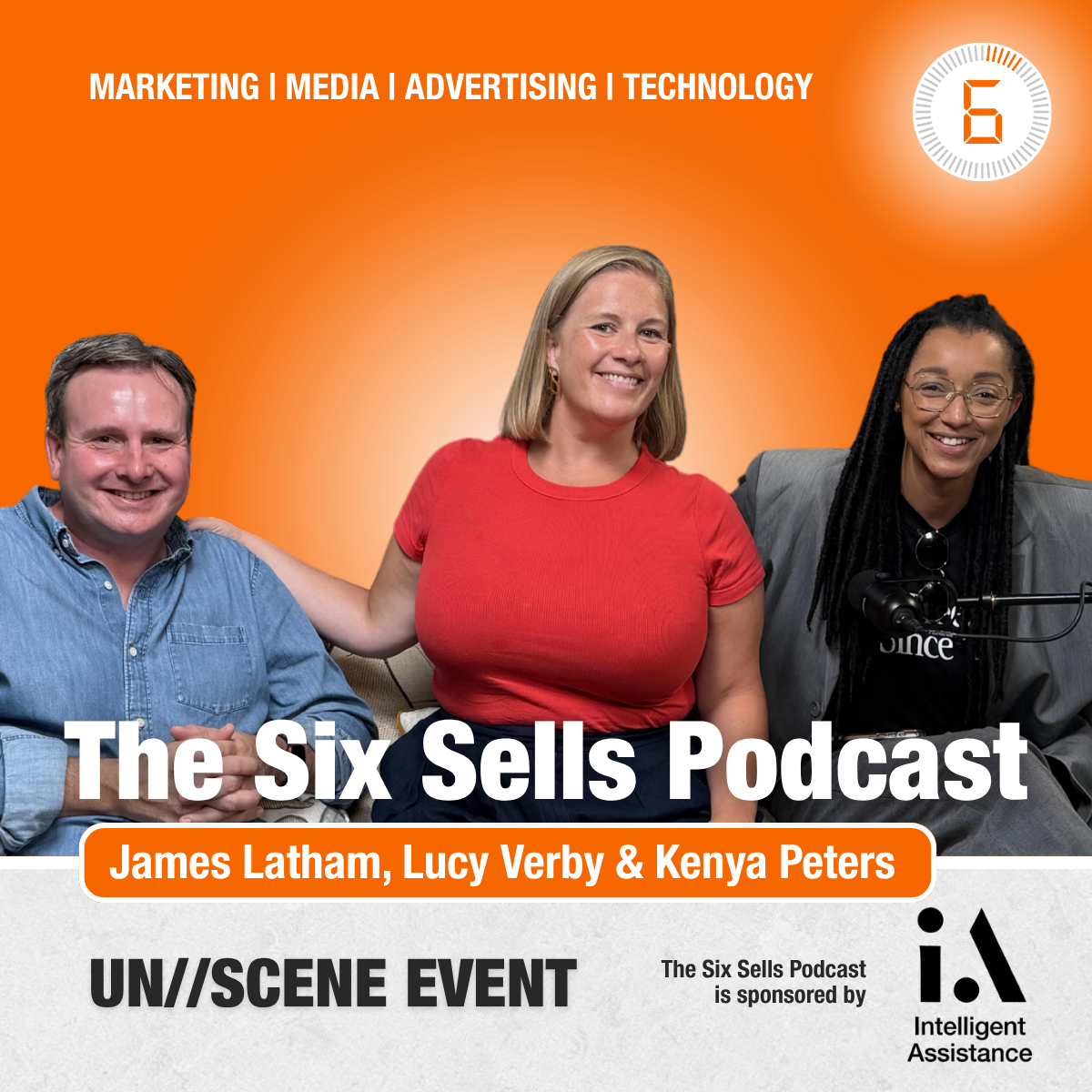
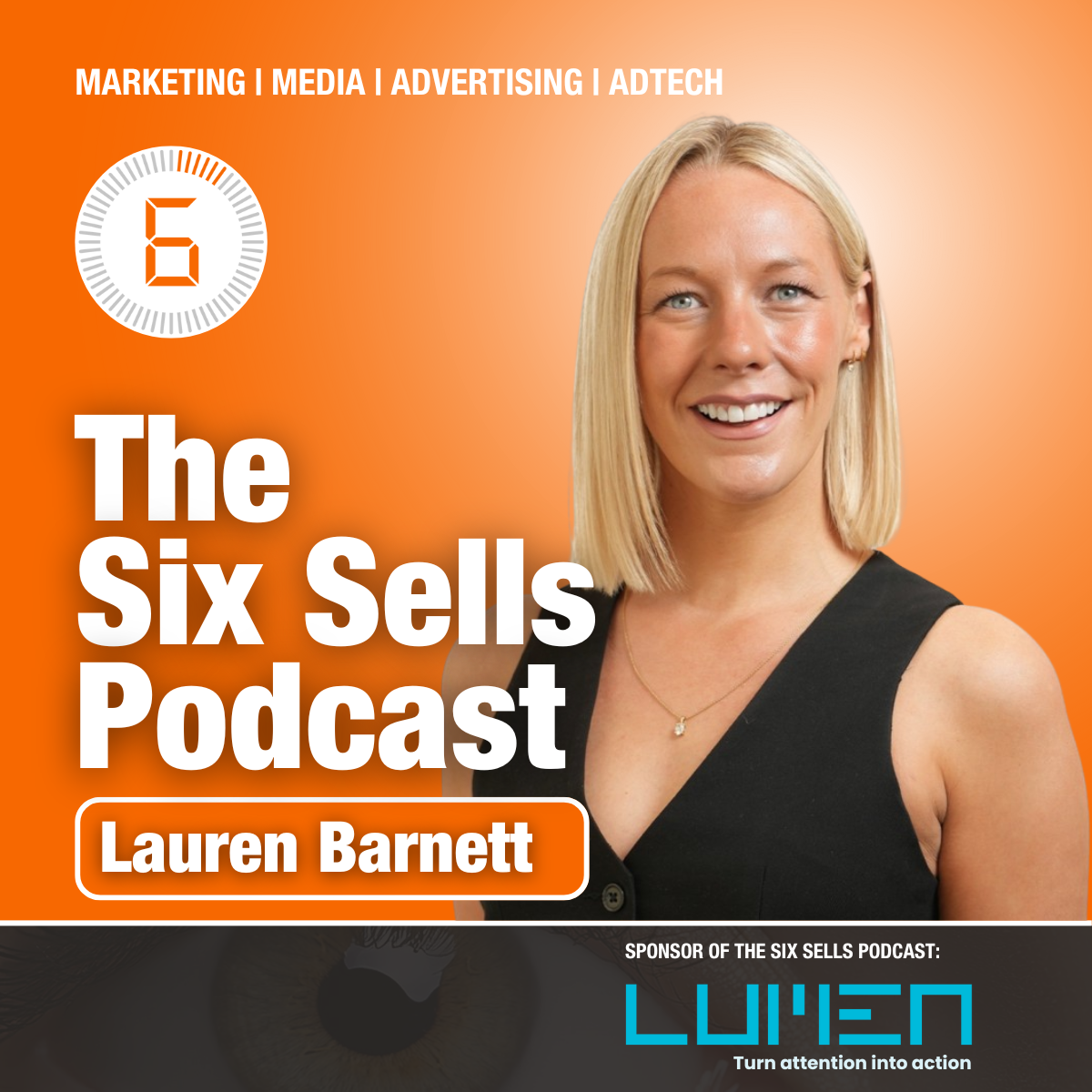
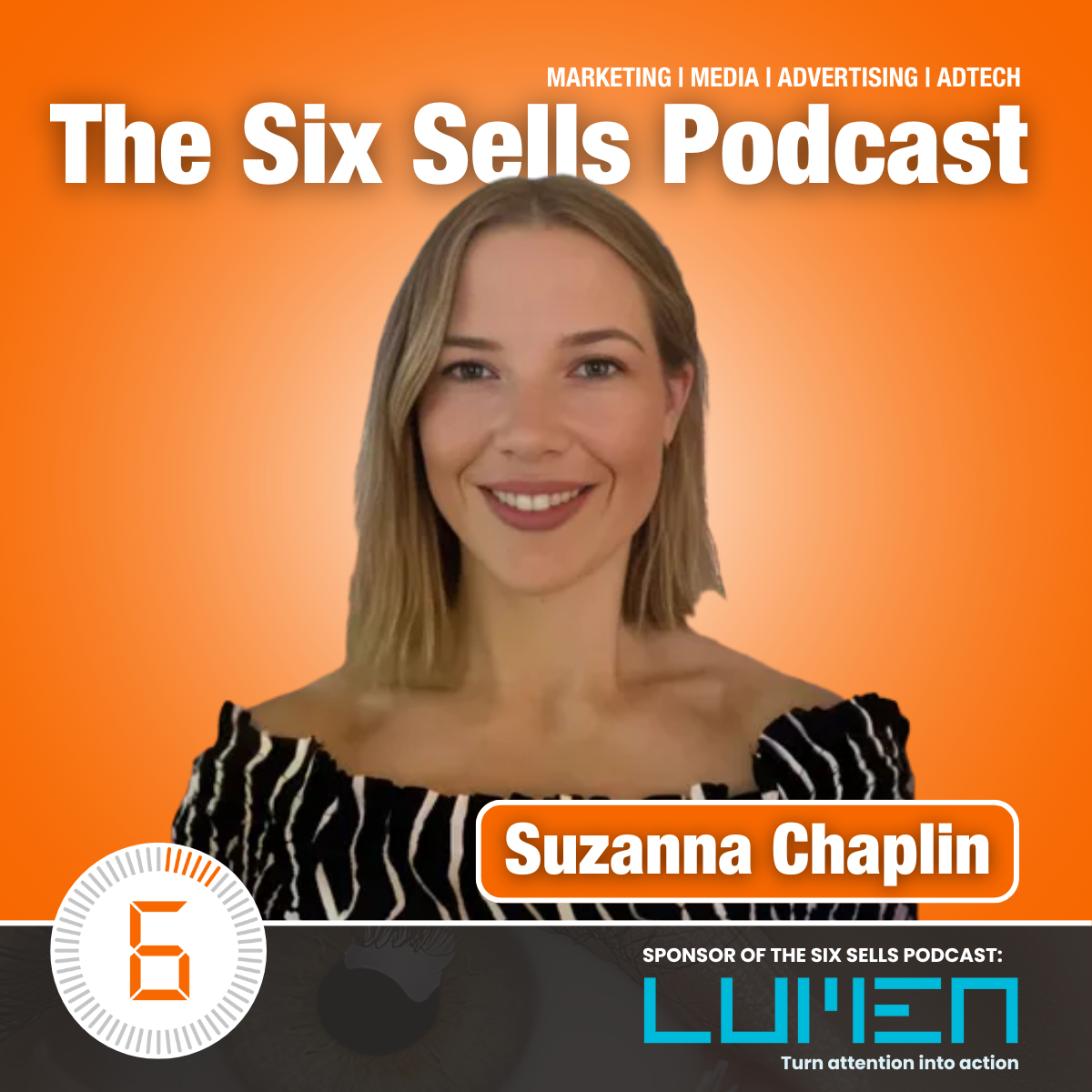
Why advertising events need fresh thinking and new voices. Lucy Verby, James Latham and Kenya Peters join Mike Nicholson on The Six Sells Podcast to explain why UN//Scene was created, how it gives new voices a platform, why diverse speakers are not difficult to find, and how industry events can create more useful content, networking and participation.
Episode summary
UN//Scene was created to bring more fresh thinking and new voices into advertising and marketing industry events.
Lucy Verby explains that the idea came from frustration with an industry that talks constantly about creativity, innovation and new ideas, while often giving its biggest stages to the same established speakers. UN//Scene was designed as an alternative: an affordable and inclusive event where people with interesting ideas can get a platform, regardless of whether they are already well known on the industry speaker circuit.
A new voice does not necessarily mean a young voice. The event is designed to surface people whose ideas and experiences have not previously received the attention they deserve, including experienced industry professionals who have never had the opportunity to speak publicly.
UN//Scene also takes a deliberately different approach to conference content. It does not want sales pitches and does not run traditional panels. Instead, speakers are encouraged to develop sessions around three principles: pragmatism, positivity and participation.
The event's approach extends beyond the stage. Networking is designed to help people move beyond job titles and existing relationships, while speakers are encouraged to stay, participate and interact with delegates rather than simply deliver their talk and leave.
As Lucy puts it: “One, fresh thinking. But then two, new voices.”
Lucy Verby, The Six Sells Podcast, published 2nd September, 2026.
What is UN//Scene?
UN//Scene is an advertising and marketing industry event created to give fresh thinking and new voices a platform.
It was founded as an alternative to more traditional industry conferences, with a focus on affordable access, diverse speakers, practical ideas and greater participation from both speakers and delegates.
UN//Scene does not run traditional panels and does not want sales pitches. Instead, speakers are encouraged to build sessions around three principles: pragmatism, positivity and participation.
The event also aims to make networking more useful and inclusive, bringing together people at different stages of their careers and encouraging speakers to remain part of the event rather than simply delivering a talk and leaving.
All profits from the event go to charity.
Date: Thursday 17th September 2026
Venue: Conway Hall
Tickets: 10% off the £99 price for listeners of The Six Sells Podcast. Type 'SIXSELLS10' when checking out here.
Why was UN//Scene created?
UN//Scene was created because Lucy Verby felt there was a lack of genuinely fresh thinking and new voices being given a platform at advertising and marketing industry events.
She describes a cycle in which expensive events need recognisable speakers to help justify their ticket price, while those speakers can often arrive with corporate-approved messages, products, books or established ideas to promote.
UN//Scene is designed to create space for ideas that may not have an obvious commercial purpose but can nevertheless challenge the industry, introduce different perspectives and help people think differently.
Lucy explains: “What I really felt was missing from the industry at large, we talk a great game about innovation and creativity and new ideas. Where were they coming from?”
Lucy Verby, The Six Sells Podcast, published 2nd September, 2026.
What does UN//Scene mean by ‘new voices’?
For UN//Scene, a new voice is not necessarily a young voice.
The aim is to find people with interesting ideas who have not previously been given the opportunity or platform to share them widely.
James gives the example of an experienced former colleague who had spent many years working in the industry and was researching ageism in advertising and marketing agencies. Despite his experience, he had never really had a public platform for his thinking.
That led to an important distinction within the conversation: somebody can have decades of experience and still be a new voice.
Kenya also argues that moving outside the usual group of industry speakers can reveal ideas that are otherwise being missed:
“When you actually start to listen to the things that people want to say outside of the regular curve of things, there's a lot of innovation and fresh thinking and ideas and things that will move the industry forward that aren't being heard.”
Kenya Peters, The Six Sells Podcast, published 2nd September, 2026.
Why does UN//Scene reject sales pitches and traditional panels?
UN//Scene wants speakers to bring their own ideas rather than use the stage primarily to promote their employer, product or service.
That does not mean speakers cannot benefit commercially from taking part. Lucy is clear that speakers are welcome to tell people where they can find out more about their work. The distinction is that the session itself should provide genuine value to the audience rather than functioning as a corporate sales presentation.
Lucy says:
“We are explicitly not here for sales pitches.”
She also explains: “We banned panels really early on.” The organisers want conversations to feel less sanitised and give speakers greater opportunity to bring their own thinking to the stage.
What makes a good UN//Scene session?
UN//Scene asks speakers to work around three core principles: pragmatism, positivity and participation.
Pragmatism means giving the audience something useful that they can take away and apply.
Positivity does not mean avoiding difficult subjects or pretending that everything is fine. Lucy describes it as making sure people leave with “more hope than harm”.
Participation means thinking beyond simply broadcasting an idea from a stage. Speakers are encouraged to involve the audience through questions, discussion, workshops, exercises or other forms of interaction.
Lucy explains: “The three core tenets that we give to all the speakers are pragmatism, positivity, and participation.”
What kinds of subjects does UN//Scene put on stage?
UN//Scene deliberately looks beyond the subjects that appear repeatedly at traditional advertising and marketing conferences.
The programme discussed in the episode included sessions on neurodivergence and magic, toxicity in leadership, matrescence and returning to work after having a child, building genuine communities, making advertising more queer, respectful rejection and the relationship between running and leadership.
Lucy also discusses bringing together speakers who had independently proposed ideas about community. She makes a distinction between creating a community to extract commercial value from an audience and building something that genuinely gives back to the people participating in it.
The intention is to create an environment where unusual combinations of subjects, personal experience and practical industry thinking can find a platform.
Kenya describes the result as an opportunity to hear ideas that would not necessarily appear at the industry event somebody attended the previous month or will attend the following month.
How does UN//Scene find diverse speakers?
Lucy argues that finding a diverse range of speakers is not as difficult as the industry sometimes claims.
The UN//Scene team deliberately looks beyond the networks and places from which traditional events repeatedly find their speakers. It also built a committee containing people with different demographic backgrounds and different professional specialisms.
The organisers then select speakers on the quality of their ideas.
Lucy says:
“We didn't find it difficult because we just fished in the right places.”
Lucy Verby, The Six Sells Podcast, published 2nd September, 2026.
She argues that when organisers broaden where they look for ideas, a more diverse group of people naturally gets the opportunity to reach the stage.
How is networking at UN//Scene different?
The UN//Scene team wants networking to be about people and ideas rather than simply job titles.
Feedback from the first event suggested delegates enjoyed the networking but wanted more structure. In response, the organisers introduced guided networking designed to help people meet beyond their existing friendship and professional groups.
The aim is to break down some of the barriers that can exist at industry events by encouraging people to start with who they are and what they are interested in rather than immediately leading with their company or job title.
Lucy explains that the audience is also deliberately designed to contain people at different stages of their careers. UN//Scene wants new entrants in the room, but it also wants senior decision-makers who have the ability to create change inside organisations.
She says:
“We absolutely have lots of new voices on the stage, but we want people who are in the room to be also the change makers.”
What is different about the relationship between speakers and delegates?
UN//Scene encourages speakers to remain part of the event rather than simply arriving, delivering a presentation and disappearing.
Mike describes attending the first UN//Scene and being able to talk directly to speakers during the day. Many stayed to watch other talks and have conversations with delegates.
Lucy says speakers are explicitly encouraged to see themselves as participants too: “You're part of the audience as well. Like, go and enjoy it, go and have fun, go and be part of it.”
Lucy Verby, The Six Sells Podcast, published 2nd September, 2026.
That creates an environment where the conversation can continue after the formal session has finished.
What did delegates take away from the first UN//Scene?
James attended the first UN//Scene as a delegate before becoming involved in organising the event.
He says he initially expected it to feel like another marketing conference, but found that the diversity of subjects and the personal nature of the sessions gave him something different.
He describes the experience this way:
“I felt more nourished, honestly, as a result of coming. I felt I had new news, new conversations to have with people, with different types of people.”
James says much of the wider feedback from the first event followed a similar theme, with delegates saying that the event felt needed and that they were pleased they had attended.
That response was one of the reasons the team decided to bring UN//Scene back.
James Latham, The Six Sells Podcast, published 2nd September 2026.
Why should someone attend UN//Scene?
James identifies three reasons to attend: the content, the networking opportunities and the opportunity to contribute something back to the industry.
Kenya adds that the event is designed to offer something to people regardless of where they are in their career.
For somebody earlier in their career, industry events can feel intimidating and it may be difficult to know who to approach or how to start conversations. UN//Scene attempts to make that experience more accessible through its format, volunteers, guided networking and participatory sessions.
For more experienced people, the attraction is the opportunity to hear perspectives and ideas that may not appear at more conventional industry events.
What is The Six Sells Podcast?
The Six Sells Podcast is for people working in marketing, media, advertising, adtech and technology. There are over 150 episodes (and counting), and the biggest episodes have achieved 30,000 views across all platforms. Want to get in touch? Email hello@sixsells.co.uk
Who is Six Sells?
Six Sells is a UK-based executive visibility and thought leadership agency that works globally with CEOs and senior leaders in media, advertising, adtech and technology.
Founded in 2018, we turn each executive's expertise into distinctive, authoritative content in their own voice, built to reach two audiences at once: the humans that matter to them, and the AI models those humans now ask for answers.
Our work combines executive ghostwriting, video, podcasts, photography and awards to build familiarity, trust and authority across LinkedIn, Reddit, YouTube, Substack, the trade press and the wider web.
We also help executives and their companies improve their visibility in AI search and large language models (LLMs) through generative engine optimisation (GEO), increasing the likelihood that platforms including ChatGPT, Google Gemini, Perplexity and Claude can discover, understand, cite and recommend their expertise.
Read more here, or email hello@sixsells.co.uk for more information.
Full episode transcript:
Mike Nicholson: Lucy James Kenya, how are you?
Lucy Verby: Really good.
James Latham: Very good.
Mike Nicholson: Welcome to The Six Sells Podcast. Thanks for being on. Second time for you. [Lucy]
Lucy Verby: Hi. Yeah.
Mike Nicholson: I think this is a debut for James and Kenya.
James Latham: It is. Thanks for having us.
Kenya Peters: Yeah, appreciate it.
Mike Nicholson: Thanks for being here. Welcome. So, we're going to talk about Unseen today. But before we do, could I get 30 seconds from each of you on your career to date, please? Good luck with that!
Lucy Verby: I'm give you guys some thinking time because I have been on before. So, I run a training business called We Are Master Plan, soon to be rebranded to Verbi Limited. It predominantly offers strategic thinking training, but through the lens of all sorts of business facets. So, strategy training purely for teams so they can work more effectively together, also planning training, pitching training, how to get better at sales, all through the thrust of if you can work more strategically as a team and think more strategically, you can operate more effectively. It's built on the back of 20 years of working with clients, mostly on the agency side, but also on the sales side, and defining a need in the market that determined that we are great at productizing and selling strategy, terrible at teaching it, which leads to a lot of gatekeeping and not enough execution. That's what I do.
Mike Nicholson: Very good. I think I was bang on 30 seconds as well.
Lucy Verby: I've said that before as well. That's not.
James Latham: So I. I spent 20 plus years in agency land, tiny ones, midsize sized ones, B2B ones, network ones, you name it. I've worked in it, always on the account management side, got up to quite senior levels in some places, loved it until I didn't. Got to a point sort of about 2022, that sort of post COVID reality of like, oh my God, it used to be work hard, play hard. Now it's just work hard. And you work harder, do more for less, et cetera, et cetera. And I just got to a point where I thought, I'm in danger of burning out here. So walked away from it, walked back into it a little bit. But then walked away properly and had to figure out a bit of a plan. What do I want to do? Got some career coaching. And over the course of that process, started to work out that actually the thing I loved about the advertising world was actually working with clients and individuals on my team, helping them develop and grow. So now I'm a business and leadership coach. I work with people who run their own agencies, people who are trying to get to that top level in businesses, and also, frankly, people like me having. Mid 40s, early 50s, career wobbles. What the hell do I do now? So, yeah, really enjoy it.
Mike Nicholson: Fabulous. Kenya?
Kenya Peters: Lovely. So I started agency side, did a bit of in house, did a bit of startup, did a bit more agency, and realized that I love the hustle of being at the beck and call of clients. So, sticking agency side for at least the foreseeable. I now work for a company called 8PM. We specialize in content integration into long form media. And for me, it's all about
Mike Nicholson: Oh, I thought. Yeah, there's a question. Yeah, sorry. What does that mean? Like, give an example. What is in content into long form? Is it product placement, basically?
Kenya Peters: Yes, but we're really. This isn't about us.
Mike Nicholson: No, I know. I looked at your website. I thought, oh, I wonder what that is. And then got busy and distracted.
Kenya Peters: Fantastic. Well, let's go then. Fantastic. So, yeah, it is. But it's really about dismantling that idea of what product placement is, especially for brands. When brands think of product placement, and if they try and think about it in a strategic lens, it is what content are we most excited about? And let's usually spend an inordinate amount of money putting our product into that in a way that doesn't really connect with people. And in fact, you'll see the case online plenty of that jarring with how people engage in storytelling and how people engage with content.
Mike Nicholson: Can I give you an example of something where I always thought product placement should have happened and it didn't? I don't really watch it like properly now, but my wife does Coronation Street. And people would go into the Rover's Return and go, Can I have a pint, please, Betty? And I go, A pint of what? No one ever actually asked for a pint. So if you said a pint of Guinness, it wouldn't jar. It would feel like it lived there and it would work perfectly, wouldn't it? So the absence of a brand actually made the programming worse.
Kenya Peters: 100 and I think people forget that a lot of the time. People don't hate brands, they just hate being sold to. So if you're seeing a brand represented in a way that makes sense to you, that reflects the life that you're living anyway, people actually love that. They go, Oh, that makes perfect sense that that character would use that because I feel like that character and I would use that.
Mike Nicholson: Fabulous. Well, you got a little pitch in there that you weren't expecting, didn't you? That was good.
Kenya Peters: Invoice is on the way.
Mike Nicholson: It's not. This is always free, by the way. So, actually, that's a good point I'm going to make now. Somebody approached me at an event and said, Would it be right to assume that everybody that comes on The Six Sells Podcast is a client of yours? I went, No, absolutely not. Actually, it's almost the opposite. But it was really interesting that somebody thought that that's what this was. And so, nobody ever pays to come on The Six Sells Podcast. Sometimes they are clients, but normally they're not. And none of you are yet. I'm going to put the word yet in there.
Lucy Verby: I massively support the work that you do and think it's brilliant and absolutely needed in our industry. So it's done with a sharing of values.
Mike Nicholson: No money changed hands for that lovely testimony to read, though, just to be completely open and transparent. So, Unseen. So that's what we're here to actually talk about today, Kenya. Brilliant. Second year, is it?
Kenya Peters: Second year? Yeah.
Mike Nicholson: Typically, when something new starts there's kind of an aha moment or a series of aha moments where the founders see a problem and think of a solution and think, oh, we could do something about that. So, could you maybe, the three of you, sort of talk to how it came about?
Lucy Verby: Yeah. So, the candid version of it is I got pissed off. I got annoyed with, I think, so many. Now, this isn't getting at any one particular industry event. I think that all have their place. And what's nice about it is that there's an ecosystem of different options to serve different purposes, some in the super corporate space, some very product led. What I really felt was missing from the industry at large, we talk a great game about innovation and creativity and new ideas. Where were they coming from? I mean, this with love, and I would happily say this to his face. I think Rory Sutherland is a true force for good in this industry. I'm not sure he needs another platform. And I kept feeling like what's happened is we've got into a vicious cycle of we're going to charge a high ticket price for this event. To justify that high ticket price, we're going to put celebrities on, or industry celebs, as we might call them, who will then talk about things that their company has signed off on, or that they are able to promote because they have a book or some other product to sell. And it goes. So, okay, I'm going to charge a high ticket price. And so, and it felt like actually two things were really missing from the industry. One, as I say, a platform for genuinely fresh thinking. The type of thinking that isn't obviously commercially viable, doesn't necessarily, you know, it's not a Google panel, for example, doesn't necessarily drive the bottom line in the most explicit fashion, but does implicitly enrich our industry, allow us to think in a different way, embrace a new challenge, tackle something that, you know, is sort of systemic across the industry. So, one, fresh thinking. But then two, new voices. It's absolutely Terrible trying to break into the kind of quote unquote speaker circuit. And actually, beyond that, just where are the faces that are going to be the headliners of tomorrow? How do we give them a stage where they can start out, start learning what it's like to speak in front of lots of people, honing the talks or the sessions that they host, and just start getting a bit of fame so that bigger events will book them? So, new voices, fresh thinking. If all of that's true How do you make sure that people go make it really affordable, make it super inclusive, make it diverse from the ground up? That felt like that was something that was missing from what we have in the industry at the moment.
Mike Nicholson: You guys should talk to the Abtech Connect podcast because they're trying to do a similar thing online. They're getting voices, the next generation of voices on rather than kind of affectionately. He said, I. I said, Oh, Matt, would you like me as a guest? Because The Six Sells Podcast produced the last, yeah, I think you're a little bit past it now, mate, because they're looking for the young, fresh voices of the future, which I kind of knew before I asked. And that's fair enough, but you know.
Lucy Verby: I will say, though, I understand, I'll slightly put a line through the word young, though. New voices, yes, not age gated. We have a brilliant, do you want to talk a bit about Nick?
James Latham: Yeah, an old colleague of mine, and I use this, the word generously. He's been in the industry many, many years. I've worked in three or four places. Being a planner, facilitator researcher for all of his career, never really had a platform. He's now, he's basically been aged out of the industry in many ways and not really got a platform to talk about what he's doing. And he's done a piece of really fascinating research for his degrees, doing masters. And this is all about ageism in advertising and in marketing and comms agencies. And I had a conversation with you know, I had a conversation with him three or four months ago, and, you know, I was involved in his research process. And I said to him, You need to get this on a stage. You know, you need to talk about this because this isn't just something for your degree. This is something the whole industry should be talking about. So we had a coffee and called Lucy and said, Can we get him on the stage? And we said, Well, get him to submit a story. And so that's, you know, he's by no means 25.
Mike Nicholson: And that's a really interesting distinction between new and young. I had assumed young, but thinking about it while you were talking there, James, Joe Blake, who was head of press at Cara, she's now head of investment at MI Media. She's 60. She's been in the industry forever. She's an absolute legend. She came on The Six Sells Podcast. It was her first ever podcast. I was like, how is that possible? How is that even humanly possible? You know? So, yeah, there are people that get missed that need a voice. I like that.
Kenya Peters: Yeah. I think you're speaking about the aha moment. Lucy spearheaded this and was like, Hey guys, I have this idea and I want to do it. And I think one, the excitement, I will get behind an excited woman wanting to do something every time. And then two, that thought of going to an event where you are excited by the ideas and thoughts that are on stage. For me, going to marketing and industry events often was just, I want to network and I want to meet people. And I'm sure there will be one or two things outside of AI and authenticity that I will also listen to. Not that we shouldn't talk about authenticity and AI, but last year, I think, was testament to the fact that when you actually start to listen to the things that people want to say outside of the regular curve of things, there's a lot of innovation and fresh thinking and ideas and things that will move the industry forward that aren't being heard. And by the excitement that came out of the room last year, I think we've really managed to tap into that and bring something that people get excited by every year.
Mike Nicholson: So you mentioned something when you were. Talking about your aha moment about people turn up to events to talk about things. That have been signed off by corporate. How do you get, rather than go left to right every time, I'm going to start over here this time. How do the speakers know that their employees are going to be okay with them talking about this stuff? Because it sounds to me, and we'll get into it, but it sounds to me like the speakers are asked to kind of speak about something that's important to them as an individual and share that with other individuals. But I don't know, let's say it was sustainability and they were working for a company that was less than sustainable, for example, that might be a problem. So, how do you get over that challenge?
Kenya Peters: I think it's twofold. And then, Lucy, you can build on this. But one, there is an element of individual autonomy, speaking about things that make you comfortable. And every submission that comes through goes through our panel. If there is something in there that feels particularly risque, but in a way that seems damaging to somebody else, I think it's our responsibility as a committee to acknowledge that, identify that, and speak with the speaker. There can be a great idea in things that are challenging to talk about. And that doesn't mean that it doesn't need a stage, but I think there is an element of responsibility of us to make sure that we're safeguarding people in that way.
Mike Nicholson: I'm thinking more about the individual and their employer. How do they get sign off to talk about? So that's you making sure that the talk is kind of safe and should be on stage. That sounds like a really important step. But how, if I wanted to, I know it's a bad example because it's my own company. But if when I was at the Telegraph, if I wanted to get involved, how would I say, right, I want to talk about how people are more important than brands, but I'm not sure the Telegraph are going to kind of back this. Do you ever have that sort of friction, or is it more Mike's coming as Mike? He's got nothing to do with the Telegraph. He doesn't even mention that he's at the Telegraph. Is this a people sort of separated from the company kind of?
James Latham: Well, we're trying to really balance that kind of thing. It's not just all about individuals, and ideally, we don't really want this to just be mouthpieces for companies. Obviously, people have to feel comfortable going back to work on Monday that they've said something that, you know, may be controversial, but every. Agency I've ever worked for has an expectation that people are interested in the work and interested have perspective, side hustles, things going on in their lives. And most people are coming in, actually, everyone that's coming into this is doing it with a perspective of how do I improve the industry for the better, make it better in some way. Here's my experience. Here's the experience of my cohort, my colleagues, my friends. Here's some suggestions on how to improve. So I don't think anyone's ever going to be directly slacking off their. Their company, or what have you. I think this is all in the interests of a greater good rather than necessarily an individual.
Mike Nicholson: It's more an individual, what the individual wants to talk about rather than the company.
Lucy Verby: Yeah. I mean, we do have representation from people talking about this is what's happening, but we were quite intentional from the kickoff that we were not going to take sales pitches. I have no problem with somebody being like, if you want to find out more about what we do afterwards, please look, you know, grab a QR code. I'm very up for the fact that we don't pay our speakers, we don't pay any of them. None of us take any money from this. All of our profits go to charity. We're all volunteers, as are the speakers. So, I'm not against anybody being able to find a way to make a bit of money from it. Go for the commercials if you can. But we are explicitly not here for sales pitches. And to the same end, we banned panels really early on. Like I've just sat through so many really sanitized panels where it's not a proper company like this. It is your point about the left to right. It is just kind of a da If I felt like there was maybe a touch of kind of, I don't know, washing going on, shall we say, I want to talk about this. I'm not going to use the Telegraph as an example, but there are many things that I suspect that would go against kind of certain corporate policies. I would be interested to have a conversation with that person and say, are you really doing this as an independent? Because I don't want this to feel like you're going out to spaces and trying to PR whoever you're working for at events and so on. So we would, to Kenya's point, we do take ownership for that, not just for. The individual in the event, but also how that plays off against what they, where they come from and what they're representing. I don't think we've had that though. We are really clear about, you know, kind of what we're designed to do. Bring your most creative thinking, bring your most exciting ideas. And if the ideas are challenging, the three core tenets that we give to all the speakers are pragmatism, positivity, and participation. Participation simply to say, we're not just here for kind of broadcasting your ideas. We want you to bring the audience in, sometimes very literally in things like workshops. We've got a play session this year. We've got some creative quests going on. Like there's some really exciting things that can be involved in. But even just if you're on the main stage, think about how your audience might interact with you, QA, and so on.
James Latham: More engaged than the money session last year.
Kenya Peters: Yeah, Insane trading back and forth, having conversations, just fully engaged. The room was oversubscribed.
James Latham: Yeah. People sat on the floor.
Lucy Verby: Well, I haven't even been on the floor this year. But it's very much, sorry to interrupt you.
James Latham: No, no, mate.
Lucy Verby: Very much about being engaged and learning and walking away from the day with something tangible.
James Latham: Yeah.
Lucy Verby: Exactly. And that's where the pragmatism part comes in, which is we want, we're sort of aware that some of these subject matters actually might, like sustainability, for example, but there's others might feel a bit heavy. So, what can people take away that they can actually go and do? And that's the kind of positivity angle with it. It's not a kind of toxic positivity paint on of an it's all fine, but rather make sure that you're leaving people with more hope than harm. And I think because we make that so explicit when people apply, and to Kenya's point, because we go through a kind of full committee judging process when we're looking at selecting the ideas, I think it makes it really clear that don't stray into something that's going to be just controversial for the sake of it. It has to serve a really clear purpose. You have to be able to represent your understanding of that and therefore show what that will mean to the audience.
Mike Nicholson: So I think it'd be a good idea to get an idea of the content and then an idea of the delegate experience. So, to get an idea of the content, maybe each of you could share one of your favorite ideas or talks that's been given in the first year, or maybe one planned for this year. Because I think the idea is we're going to get this out on the day that. Unseen launches. So if you want to talk about something that's coming up in this year's show, this won't be out before then, if that makes sense.
Lucy Verby: Oh, okay. I thought, well, if we can get it out a couple of days before.
Mike Nicholson: Oh, okay. So ticket sales, yeah.
Lucy Verby: Yeah. As always, because we've got tickets.
Mike Nicholson: In that case, don't talk about this year's show. Let's leave that as a surprise.
Lucy Verby: Oh, no, we can. We can, because we're actually, to be honest, we want people to sign up for the sessions in advance. So if you've already got a ticket, you get your first priority access to the sessions because we will be capping them this year after the. People sat on the floor incident last year. We are going to cap the rooms. So we will have a pre sign up list that people can.
Mike Nicholson: In that case, I'm going to change the question. If you could only go to one talk for this year's event, which one would you each go to and why?
Kenya Peters: Magic.
Mike Nicholson: Go on. Talk to me about magic.
Kenya Peters: Yeah, we have a magician. He's talking about neurodivergence and magic and how the two, I'm going to butcher this. So he's talking about neurodivergence and magic and the kind of ways in which bringing magic, I'm going to butcher it entirely.
Lucy Verby: No, he's always right. He's talking, no, no, it's lovely, mate. You're absolutely right. He's talking about the interaction of the two things. So he's a magician. He has dyspraxia and he is talking about how he has been told many times in his life that there are things that he won't be able to do, for example, juggling, which is something he's teaching himself at the moment. And it's not a kind of, hey, I'm a very, very neurodivergent person. And it's not a kind of, hey, neurodivergent people, you just need to try harder and then you can overcome it. It's not that. But it's actually, if there is something that you really want to achieve, these are the kind of ways and means in which he has been able to just fulfill his life's passion of being a brilliant magician.
Kenya Peters: So it's stories about how he has achieved things despite the neurodivergence.
Lucy Verby: I think not even despite, I think it's just like this is how it was. He was told he couldn't do things and now look what's being achieved.
Mike Nicholson: So yeah, you're going for magic and neurodivergence.
James Latham: I'm going to cheat. So there's two that I really want to go to. One is Joanna Howes, who is an ex colleague of mine. She's doing a session on It's called Toxicity is Everybody's Business. So, the notion of toxicity and leadership, and everyone's worked in a place where they've worked with awful people, right? And the notion of how does that just move out of the sea?
Mike Nicholson: You haven't, it was you.
James Latham: Well, exactly.
Mike Nicholson: You're the guy with a Venn diagram.
James Latham: Yeah, So, that's going to be really fascinating and trying to take that away from just being the HR director's problem or the CEO's problem, just thinking about that as a breadth topic. But there's another one we've spoken to a woman called Emma Quits. Lloyd who's got this topic called matrescence, which is the notion of how your mind and body gets rewired slightly after you've had a child. And when you come back to work, you know, I've been on the receiving end as a sort of manager and sort of going, oh, someone's come back to work. I need to think about, you know, their flexible day and all this kind of stuff and looking at it through that lens. And she's talking about, no, there's actually a slight rewiring to the way. That your neuro pathways are. So it slightly changes you as a person. And how do we educate, you know, HR people, managers, and others to receive someone back to the workplace with a bit more understanding and clarity? It's about how that person has changed.
Lucy Verby: They're all my children. I like them all. I, not to pick anyone, they're all going to be amazing. There is a particular session which I'm super looking forward to because I think it's very pertinent, which is Lou Nylander and Amy Dorakakis and Eve McDonald who three people who all applied with separate ideas about community to us. And one of the things that we always say when people are applying is, we might like your idea, we might make it into something slightly different. And it just felt like they'd all built these incredible communities. You know, Lou's built Wildflowers of London over, I think, 10 years now, it's been going. And so there's a really established understanding of what it means to not just build a community, but to sort of understand how to let it be outside of yourself. So it's not, I think there's a lot of stuff being chattered, I'm you're all finding about community at the moment. And I think for some people, they think that this is basically a bit like social media followers, a sort of way to be able to monetize crowds and extract rather than input. And I know from, well, I don't know Eve so well, but I've seen amazing work that she's done. I know Amy and Lou and the work that they've done within their communities very well. And there's definitely both from them about enriching and giving to the community and letting it. Grow rather organically outside of their own kind of agency, I suppose. They're not trying to be jealous about it. They're trying to make it be useful and helpful and be useful and helpful to it. So there's a great piece about what it means to successfully and with longevity create a community that grows and thrives and is enriched by it.
Mike Nicholson: Sounds like a real world Reddit. I signed up for Reddit about seven years ago and didn't use it. And then because GEO demands it now, I started using it again. And what you find is because a lot of people are anonymous, like there's an ad tech, there's an advertising, there's marketing, there's all sorts of subreddits that are relevant. They talk really honestly. But they go there to help. So, somebody asks a question, loads of people try and help with the best of their knowledge. And that's a very different experience to LinkedIn. You don't get that as much on LinkedIn, maybe because it's always attached to yourself and like you don't want to look stupid or whatever. Whereas people on Reddit don't care because no one knows who they are. But there's that idea of don't show up here and try and take from this community because they'll shut you down and hate you and downvote you and all sorts. But if you show up and give to the community, you end up getting back from that.
Lucy Verby: Absolutely. And that's that was so beautiful. But other, you know, we've got how to make ads more queer, a kinky, thinky workshop, how running improved my leadership, how to give respectful rejections. Like it's just a plethora of gorgeous, interesting thinking that, yeah, I just, I can't, we can't wait, can we?
James Latham: Yeah, it's a really interesting blend of quite tough, edgy subjects with a practical outcome and so on, but with creativity and levity as well. So I think it's going to be an interesting mix.
Lucy Verby: Quite a lot of sex and magic this year, which I'm quite excited by.
Mike Nicholson: Which is missing from the book. If that's not the sale tickets, nothing is.
James Latham: And then the big question mark session.
Lucy Verby: Laura's session.
Kenya Peters: Yeah. The mystery session.
James Latham: The committee know about. She's come to us. She has an idea. And we're entrusting her. Lucy and I were on a call with her the other day and she said, Well, shall I tell you all about the session? I was like, No, I don't want to know. You know, this is going to be exciting. You know, and it's all about curiosity and getting curious people into a session that they don't know the rules and the.
Mike Nicholson: Interesting. Yeah. Interesting. So that's the content. And thank you for sharing that. So, when you talk to delegates that were there last year, if you ask any delegate of any event, they'll put it, oh, yeah, it was good. Some sort of generic sort of answer. But can you think of some of the sort of feedback that you got that kind of spoke to the difference that you're trying to make with the event?
James Latham: Well, I mean, I was that delegate last year. So I went because, you know, I knew one of the committee. You know, she's an old colleague, friend, and so on. So I thought, you know, she's been working her ass off to make this happen. So I'm going to come along and show my support. Didn't really think much of it, really. I just thought well, this would be another kind of marketing event, but oh, that's quite cheap. And I don't have to get a CFO to sign that off. So that's great. And, but what was interesting about it was just the sheer diversity of topics that were not just, to Lucy's point, brands on stages, the sales pitch, and so on and so forth. These were real stories from real people. And I came away from it thinking, you know, as someone in the coaching world, you know, my entire day to day is about people's experiences, how they're affected, and trying to. I felt more nourished, honestly, as a result of coming. I felt I had new news, new conversations to have with people, with different types of people. So, yeah. And a lot of the feedback was quite similar. Some of the quotes we saw were stuff like that.
Mike Nicholson: You see, so you liked it so much, you got involved.
James Latham: Yeah, I did. Exactly that.
Lucy Verby: I mean, very lucky for that as well.
James Latham: Yes. We needed Jobs this year. I texted her and I said, you know, do you reckon Lucy or you would need the help? And I don't really know why I did that. I think I was like, you know, was it pure altruism? Was there a bit about getting myself back into the industry? Probably a combination of those things. And, you know, it's such a meritocracy and such a lovely group of smart people. You thought, this is great, great to hang out with these guys.
Kenya Peters: But the number of people, even. This year, I know we're on a call this week and you have speakers being like, and how can I help? And should I do this? And it's just such a great committee and community of people who are, to the nature of the event itself, wanting to see change and do good and give back into the industry. And I think that really shines through.
Lucy Verby: So much of the feedback was literally just a copy and paste almost of this was so needed. I didn't realize how good this would be. And I'm so glad that I came. And yeah, I think the feedback was really a motivator to make sure that we did bring this back again. Kept going.
Mike Nicholson: Very cool. I'm going to think out loud now, and that rarely goes well. So hopefully it'll be okay. But I had an idea recently about donating time. So the idea was I put it on LinkedIn. Some people said they'd get involved, but it needs a bigger audience. But basically, the idea is if everybody gave. An hour a month of their time into a pot, and then people that needed help in the industry could say, I need help with X, Y, or Z, and the system basically connected the need with the experience, then it would only take an hour of my time, but I'd better help somebody. Whether that's learning about what it's like to work in press or running an agency or whatever it might be, or even just can you review my LinkedIn profile because I'm not getting anywhere, whatever it might be. But if you scaled that, that's a bit like Pay It Forward, right? Do you remember the film Pay It Forward? It feels like you could do something like that in real life. You could have, like, as delegates leave, you could say, what would you really like help with? Like, if you were just being really honest, don't tell me, like, you can make it anonymous or whatever, and then pitch out who is the best person to speak about that. You could kind of make it an exchange of, This is what I like, this is what I want to know, this is what I want to learn about, and this is the right person to do that.
Lucy Verby: Yeah. It's really interesting, to be honest. I mean, kind of what you described just describes the way that when I left agency, I designed my whole career. So, with my training business I give away pro bono spaces on my training courses a couple of times a year to people who are out of work or returning from parental leave or just having a bit of a shit time and all sorts of things. And I always kind of think my corporate stuff pays for my life. So, everything else I do tries to just, I think, give back to the actual community, give back to the industry that made me and to look after people. I really like the idea of asking people what they want. I think we could maybe think about that when we, because we've got kicking off the day this year, a new thing that we didn't have last year feedback, was people were asking, We really loved it. The networking was great. It'd be good if it was a bit more structured. So we have two brilliant women, Susie and Ramona, who are doing guided networking at the kickoff. So if you come, we say we start at 10, but we actually start at 9 15. So people can arrive and do some kind of guided networking. So not just chuck you in a room and go for it and maybe end up talking to your mates and one new person. Susie and Ramona will ask, put you into kind of groups, organize you in a particular way, ask you specific questions, just allow for you to kind of break down barriers without leading with your job title. So, not starting with because we're really clear with our outreach. We absolutely have lots of new voices on the stage, but we want people who are in the room to be also the change makers. So, we have outreach, yes, to new entrants into the market. We do extra doubly massively affordable tickets with partners like Brixton Finishing School, Ali Hannon's Creative Equals, Digi Learning groups, but we also make sure that we're directly speaking to, you know, I know. David Wilding's coming and Venya from Spark Foundry's coming, and we make sure that the C suite's in the room because they're the people who can impact change. And the networking is designed so that nobody leaves with the titles. They lead with, you know, kind of who are you? I'm interested in hearing from you. What are your ideas? I like the idea of asking people what they need out of the day. I think that's really cute. We could look at building that in. Thank you.
Mike Nicholson: You're welcome. Always here for nice ideas. Sometimes thinking out loud does work.
James Latham: Well, we do have, I will also say this the speakers themselves, there's a very exciting announcement that we can't officially make yet, but will be about how the speaker talent can grow their platforms in the future. So if you come along to the event, you will see what that looks like and we'll provide. For, we hope, really fulfilling on the promise of Unseen, which is we'll give you a stage and that will help you get onto more stages. So, we have some structure to it.
Mike Nicholson: I might be able to offer something free for that because we help execs to sort of build their personal brand and get themselves out there and stuff. So, if you want anything from us that would be a follow up.
Lucy Verby: Love that.
Kenya Peters: Yeah, love that. Thank you.
Lucy Verby: You know, I'll take you up on that.
James Latham: Yes. Thank you so much, buddy. There's no embarrassment here. We will say yes.
Mike Nicholson: We'll say yes. And it's on camera, so there's no getting out of it. Okay. So, okay, a couple of days before then. So we'll get it out as quickly as we can. So there's still ticket sales to be had here. Why should somebody come to Unseen this year?
James Latham: Well, firstly, great content. Secondly, networking opportunities. Thirdly, doing their bit for the industry. Ie every single penny is going to charity it's going to NABS going to MediaWrite going to Lollipop Mentoring So, you know usually you pay these big chunks of ticket price and it goes to a corporation This is not going to me it's not going to Lucy it's not going to Kenya? It's going back to those charities So yeah I think that's pretty good.
Mike Nicholson: Brilliant Kenya.
Kenya Peters: I think no matter. Can you? I think no matter where you are in your career, there's going to be something that you can take from it. You're either going to hear things that you're not going to hear at the event you went to last month or the one that you're going to next month. And if you're younger in your career, going to events can feel quite intimidating. You don't really know who's in the room. You don't know how to engage with people. You might be really chirpy and be like, I can do this. Or you might be really reserved and be like, I want to do this, but I don't quite know how. And I think the way we've structured this, particularly with some of the sessions and how we've built them, but also just with the volunteers that we have in the room, the committee and our incredible volunteers that also gave up their time to help, it's a great way to go into a more accessible environment.
Mike Nicholson: Speaking of accessibility, it is very affordable. I think that point about Accessibility is interesting because often at these events, the speaker comes on from some green room, goes back into the green room. And I found last year as a punter, you could just go and have a conversation with one of the speakers throughout the afternoon. And they were often just hanging around watching the other talks. And they weren't angry about that or frustrated about that. They were excited about having conversations with people. So that's quite nice, I think.
Lucy Verby: Yeah, we actively tell them, you're part of the audience as well. Like, go and enjoy it, go and have fun, go and be part of it. And that's it.
Mike Nicholson: So, you don't get speakers coming, do the speech, and then leave again?
James Latham: No, one or two just based on timeframes. But most people are really up for talking about what they were saying, learning from other people. They get the ethos of the day. And quite frankly, it's fun. It's a good day out. You will learn stuff absolutely. It's really enriching. There's all the kind of validity. But at the end of the day, it's just a really good day of exciting stuff.
Lucy Verby: I would also add, which is if you are somebody who is involved in events or getting people to speak on stage or anything else, I'm apologies if I swear at this point because this is where I become really passionate. I will not fucking hear from you about not being able to find non cis white men to speak on stages. Oh, it's really hard. Oh, but the people who are in the jobs are no, no, no, no. We did not find it difficult year one, year two. We have never found it difficult to go and find people who represent, you know, every gender not just white people, you know, myself, queer people, neurodiverse people, like people of all ages. We didn't find it difficult because we just fished in the right places. We made sure that the committee was a great cross sectional representation, not just of demographic diversity, but also specialist diversity. You can just see from the three of us, we come from different backgrounds in where we've worked. We made sure we fished in the right places so that the ideas that we got were compelling and exciting. People are always just selected on the basis of the quality of their idea. But oh, look, when we look back at who is on the stage, it ends up being a very diverse representation.
James Latham: No panel, no mannel.
Lucy Verby: Yeah, yeah. No panel, no mannel. I'm going to say that on the kickoff day. Thank you. I'm nicking that.
Mike Nicholson: I think that's probably a function of looking for new voices as well, though, because if you look for existing voices, it can be quite straight white man.
Lucy Verby: Maybe. I don't know if I agree with that because I have lots of mates who are in those positions and I think they just don't get asked enough. Like, you know, I have some, again, in the audience, as I say, we have C suite representatives. And yeah, of course, there is an enormous problem with bias that gets harder and harder to battle against. As you kind of move up the hierarchical ladder. But I also think that people are just a bit, I think they've gone back. I think we've gone backwards. I was talking to somebody the other day who runs some big events and he's very interested in making sure that there is proper kind of representation on stages. And he said he goes to events and he said, I just think people aren't trying anymore in the way that they were trying sort of five, even sort of seven years ago. People aren't trying anymore and they've stopped being bothered. Like I find it really grim. And so it's something that we are. We have railed against in every part of our structure, and also true of how we are working with people who are going to show up on the day as well, you know, to make sure that everybody comes along. And one woman who worked for NABS last year said, Christ, Lucy, this is such a safe space. Like, it feels really good to be here. And I thought, well, all right, cool. We can still always do more, and we're always open to feedback about how we can improve on things. But yeah, but just come because it's fun.
Kenya Peters: It's great. It's just a really good day, isn't it? It's just lovely.
Mike Nicholson: I am sold. I will be there. And we've run out of time. So, any final thoughts from anyone before we.
Lucy Verby: I just want to say a lovely thing for our sponsor. So, when this goes out, they will have officially been announced. Our sponsor is Craft Media, an incredible agency doing brilliant things. Their anti process planning book that they recently launched, I think, is exactly what the planning world has needed for a long time, which is about not just homogenizing planning or sticking it all through AI, but actually going back to, as per their name, the craft of planning and how important that is and how important it is to understand and represent audiences in a really meaningful way. So, Sally and Jen will be both at the event. They're the founders of Craft and we'll have a couple of their team speaking on the stages on the day. We are really clear about our values extending to our sponsors, and they absolutely align with what it is that we want to try and do. So I have turned down sponsorship money from nefarious brands in the past, and we are super, super excited that they are our main sponsor for this year. So we cannot wait.
James Latham: Fabulous. I think just a thank you really to everybody that supported the event last year, that's going to support the event this year and will in the future. The events industry in itself is hard and challenging, and I think people on the committee are. We're all volunteers, we put our time into this because we want to see it come to life. So, everybody that comes, everybody that buys a ticket, really helps spur us on to kind of keep making sure that this can come to life.
Mike Nicholson: I guess the final one is it's on the 17th of September, it's at Conway Hall. How much is it?
Lucy Verby: 99 pounds. Discounts are available for those who need it.
Mike Nicholson: There we go. Thanks, everyone. Thanks for coming in.
Lucy Verby: Thank you so much.
Mike Nicholson: I look forward to the event.
James Latham: Brilliant.
Kenya Peters: Thank you.
.png)

.png)




.png)









.png)




.png)


