As we plan for 2027, traditional selling strategies are no longer enough.
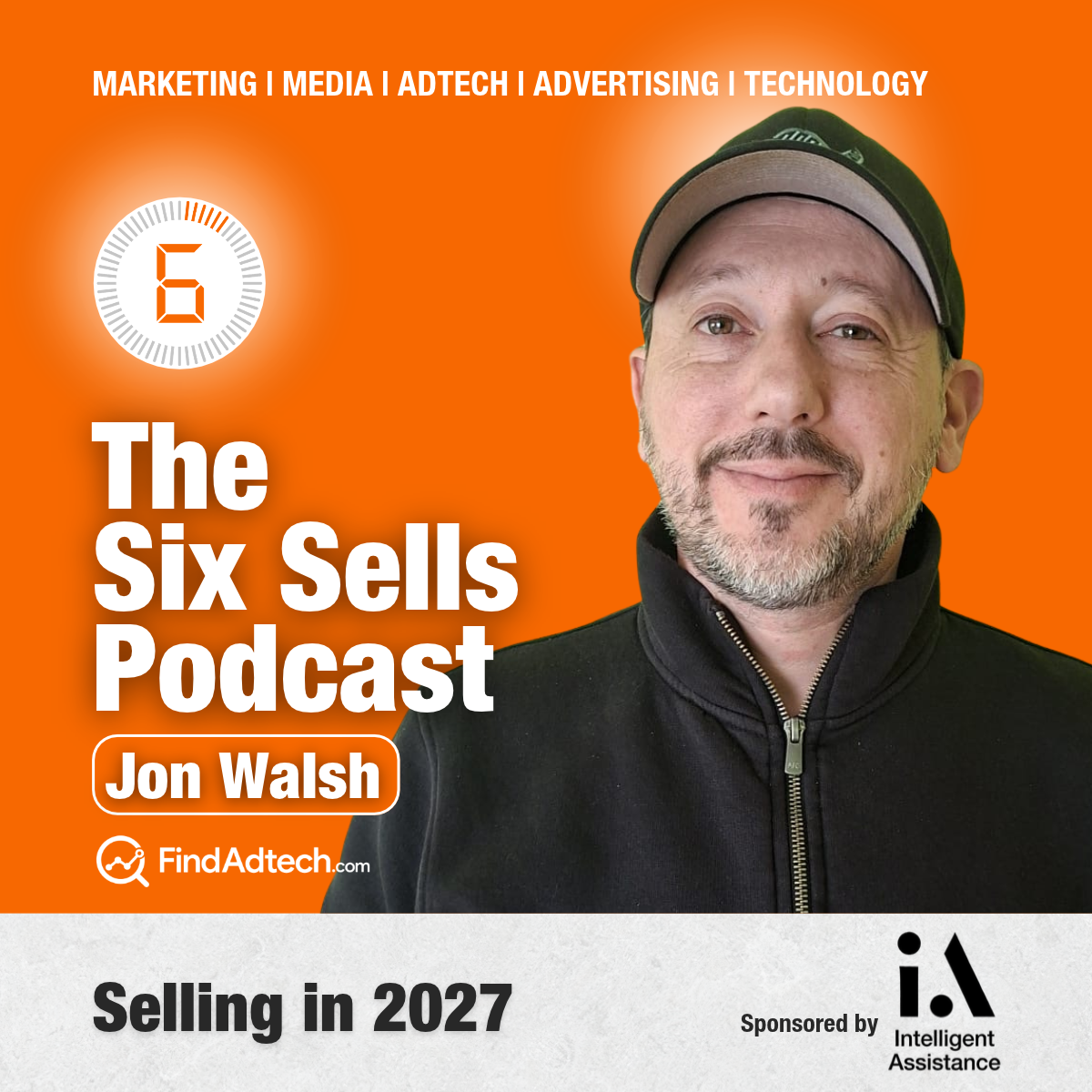
In this episode of The Six Sells Podcast, I spoke to Jon Walsh, the creator of the popular Adtech Chat WhatsApp groups, and FindAdTech.com.
Over time selling media and adtech has become more difficult. Jon and I charted that from the removal of the desk phone at agencies, to the advent of email automation, AI, through to tighter vendor partner lists.
We discuss what is making sales harder, and how companies can cut through in a crowded, busy marketplace.
Jon is the Co-Founder of JobsInAdTech.com and FindAdTech.com alongside founding the WhatsApp Adtech Chat Community which gathers together over 16,000 members who connect, debate and interact throughout the world.His impressive career spans 25+ years in digital advertising both as an entrepreneur/angel investor building various media sales companies in the space, and as a senior executive within corporates.
He is also a published author, contributing to the highly successful Understanding Digital Media series of books.
Topics discussed include:
• How the sales industry has changed since the removal of the desk phone
• The nature of how agencies have restructured and how relationships have shifted
• The risk of stalling adtech innovation
• The challenge of making yourself familiar
• The email ‘triage’
• Thinking about how you sit as a brand in someone’s brain
• Marketing as a ‘pull’ as well as a ‘push’
• Finding the Adtech community all in one place
• The importance of creating great products
• Bias, truth and what was actually said
• Avoiding the echo chamber of marketing
• Achieving relevant reach
Check out FindAdTech here
About The Six Sells Podcast
The Six Sells Podcast is for people working in marketing, media, advertising, adtech and technology. There are over 150 episodes (and counting), and the biggest episodes have achieved 30,000 views across all platforms. Want to get in touch? Email hello @sixsells.co.uk.
Who is Six Sells?
Six Sells is a UK-based executive visibility and thought leadership agency that works globally with CEOs and senior leaders in media, advertising, adtech and technology.
Founded in 2018, we turn each executive's expertise into distinctive, authoritative content in their own voice, built to reach two audiences at once: the humans that matter to them, and the AI models those humans now ask for answers.
Our work combines executive ghostwriting, video, podcasts, photography and awards to build familiarity, trust and authority across LinkedIn, Reddit, YouTube, Substack, the trade press and the wider web.
We also help executives and their companies improve their visibility in AI search and large language models (LLMs) through generative engine optimisation (GEO), increasing the likelihood that platforms including ChatGPT, Google Gemini, Perplexity and Claude can discover, understand, cite and recommend their expertise.
Read more here, or email hello\@sixsells.co.uk for more information.
Full episode transcript:
Mike Nicholson: Hello and welcome to The Six Sells Podcast. My name is Mike Nicholson. I'm your host today. I'm going to be speaking to John Walsh, the founder of Jobs in AdTech and The AdTech Chat. John, how are you?
John Walsh: I'm doing great. It's a nice warm day in London.
Mike Nicholson: A very warm day on the Victoria Line in particular. But by the time people are listening to this, sadly, it'll probably be raining or some such horrible English weather. Thank you for coming in. Much appreciated.
I wanted to start off, if I may, straight in with a hard question, perhaps, or maybe it's an easy one. I don't know.
If I could make you 18 again, so it's the year 2024 and, poof, you are now 18 again, would you still embark on a career in adtech?
John Walsh: Do you know what? I think that if I could go back, actually earlier than 18, I'd have worked much harder at school and I'd have got into something like banking or finance.
I just had a love for advertising from literally being seven or eight years old and loving the TV ads of the time. I always wanted to work in advertising, although I used to think that working in advertising was about making the ads. I didn't really understand the media side of it.
Mike Nicholson: The slots that the ads go in.
John Walsh: Yeah. I never thought about how they get there. And I managed to get a job in ad sales when I was in my very early twenties.
I don't regret getting into advertising. I still think it's a fascinating industry.
Adtech itself is a fairly recent phenomenon, with the rise of technology and the rise of the internet and how ads get placed. A lot of the time, I think adtech is almost synonymous with programmatic, really.
I do find the tech stuff really, really interesting, but I also think it's opened up a lot of questions about when we use technology, it means that there's some stuff that we can't see. And there's a lot of trust required.
I come from a press background, and then I worked at the Telegraph in digital before programmatic.
I remember clients ringing up in the really early days saying, "Well, we've been on the website and we've looked around and we can't see our ad."
It was a genuine question. At the time, it was like, "Well, you can't be running our ad because we can't see it."
They're not thinking that there's billions of impressions and you're just some of those impressions.
Mike Nicholson: Well, I come from the same background. I started in print and press a long, long time ago. I was at the Independent.
I saw this digital thing, or the internet thing, in 2000, going, "That looks exciting. I want to get into that."
But it was mostly out of frustration and boredom with just selling quarter pages, half pages, full pages and double-page spreads.
I stupidly thought there would be much more creativity in a digital world. That's really why I jumped.
I didn't have the vision for how big the internet could really be, or the World Wide Web would really be, and I've just kind of semi-blindly ridden that wave ever since.
So the answer to the question is yes, you would?
John Walsh: The answer to the question is, I think if I really thought about it, no, I probably wouldn't.
I would try and do something that either I would make much more money in or would try and change the world a bit more in.
The path that I took wasn't the university one, and I think that restricts a lot of choices.
If I could go back in time or start at 18 again, I'd probably go to university and that would open up a world of more options for me.
Mike Nicholson: I wonder how many other people would do the same.
I wasn't brilliant at school. I didn't like the academic route and didn't go to university.
Now, when you're a bit older, I actually have a love for learning, but I didn't have a love for learning when I needed to, when the exams were happening.
Very interesting.
So, John, it's your lucky day. I've made you 18 again.
John Walsh: Thank you.
Mike Nicholson: And I'm now going to make you the leader of the adtech world, for this very brief podcast episode, unfortunately.
I'd like you to tell us, please, one thing you would like to start, one thing you would like to continue and one thing that you would like to stop, and then the reasons why you've chosen those.
John Walsh: One thing I'd like to start is I would like to see companies open-sourcing their technology far more, sharing their methodologies around things far more.
I think it's really hard for us to create distinctions between different SSPs or different DSPs or ad verification companies without really understanding the technology a lot more.
To see that open-sourced and shared more widely could help companies create their own distinctions more, and you'd be able to see which horse for which course.
That's what I'd like to see more.
In terms of continuing...
Mike Nicholson: Could we stop there just for a second? I think that's a really interesting one.
I was talking to one of the many companies that say they optimise towards attention recently, and they said they couldn't tell us everything that they measure because that's their IP.
If they were to make it open-source or available or transparent, whatever you want to call it, then everyone would be able to copy it.
Where do you draw the line between, "We've got our secret sauce here that seems to work. We want to be transparent, but we don't want to be so transparent that it could be copied"?
John Walsh: I still believe that being transparent around that, you've got more to gain than you have to lose.
Let's say you've got some secret data that you've got access to. It's not really that secret because you're probably going to be paying for it, or you're not paying for it and it's being kind of swiped somehow and you don't want to talk about it.
Transparency is about shining sunlight on something.
I think too many companies overvalue, not their IP per se, but their methodology.
From a marketing perspective, being open and transparent is always going to win. You gain trust by doing that.
Especially if people can go, "I'd love to take a little look at your code."
I could look at the code for Google. It doesn't mean I can replicate it. I could look at the code for Facebook. I can't replicate it because where they win is on the network effect.
Even if you have a certain way of doing something, unless you have high volumes of that data and it comes from good-quality sources, then it comes to a contract question.
Can you lock that up contractually? Then you can talk about it.
Otherwise, I just think trust is far lower if you're not more transparent.
I think on an Edelman survey, we came lower than bankers and politicians at one point, didn't we, advertising?
Mike Nicholson: I think we still did. I remember tweeting about it about three or four months ago.
I was like, "We took one step up."
Although I think it was politicians that had fallen below us, and I questioned whether that was us stepping up or them falling lower.
John Walsh: Yeah, for sure.
Mike Nicholson: So that's one thing you would like to start. Something you would like to continue?
John Walsh: What I'd like to continue is just the awesome community, the networking, and I really don't like the word networking, but the camaraderie that I feel is present in the industry.
The level of rivalry that we see with each other, or used to see with each other, I think has fairly dissipated from the CEO level down to the executive level.
I think that's great, and I think it will help push the industry further forward faster.
Mike Nicholson: Do you think that rivalry, or the dissipation of that perceived rivalry, is because now essentially absolutely anyone could be your rival?
It's so difficult to identify who your rivals might be.
Going back to my press days again, I was at the Telegraph. I knew that the Guardian were our rival and the Times were our rival.
But now it's like anyone that has media to sell is a rival. You can't hate everyone and you can't be suspicious of everyone, right?
John Walsh: Fragmentation of media means that there aren't that many rivals. Sorry, everyone's a rival, no one's a rival, right?
I think that in the social media space, sure, Facebook and TikTok and YouTube and Snap rival each other for ad budget in a truer sense.
But one of the wonderful things that I've seen over the last few years, and I've seen it firsthand, is the Independent, the Telegraph, the Times, News UK, Reach plc, all of these guys no longer have the same level of rivalry.
I run a publisher WhatsApp chat just for publishers, and the support they give each other, the help they give each other, the insights they give each other over what's actually happening for them, is really admirable and impressive.
I can't talk highly enough about how these guys are much more open and supportive of each other.
In a programmatic-first world, your brand means so much less.
Mike Nicholson: I totally agree with the people thing and the networking, although maybe that isn't the right word.
Just on the way here to meet you, I surfaced at Oxford Circus tube station, bumped into Jonathan Westbrook. I was early, we had a quick pint, caught up with the world, and on we go.
John Walsh: It's lovely, isn't it?
Mike Nicholson: It's always going to be about the people. The technology is what perhaps everyone focuses on, but it's about the people that are operating that tech, for sure.
John Walsh: Totally agree.
Mike Nicholson: That's one thing you would like to start, one thing you would like to continue. What would you like to stop?
John Walsh: What would I like to stop?
I think this is actually a far harder question.
To be honest with you, rather than just giving a bullshit answer just to try and fill it in for you, I can't think of anything specifically.
I think trajectory-wise, we're doing fairly well. Continuing the transparency, I think, is important.
So ending something, there isn't really...
Mike Nicholson: The Google cookie saga. That feels like it could go into Room 101.
John Walsh: I think the evolution of everything is great. Each company has to do what they feel is right for them, and then the market reacts and entropy continues.
Mike Nicholson: Fair enough.
Talking of the people, Jobs in AdTech. What was the inspiration behind it, first and foremost?
John Walsh: Jobs in AdTech primarily came out of a need that I saw, a gaping hole in the industry for how people can get hired and how companies can find people to hire.
It was the end of 2022. We had layoffs left, right and centre. Pretty much, I can't think of a single company that wasn't impacted.
I'd set up a WhatsApp group specifically for adtech jobseekers.
At the time, I thought I would monetise it by charging a small fee to recruiters to be in there, and they'd be able to share their jobs and talk about what they're up to and support candidates.
I kept running into brick walls.
Recruiters were like, "Well, we already have a large database of candidates. We don't need to pay for this."
Which I can respect.
However, I kept trying to push on the fact that this is about your brand. This is about how you talk and interact with people and becoming a really valued company within the space.
A few months later, a buddy of mine came to me with a suggestion, actually.
It kind of made sense, but I wasn't really that into it.
Then I started the search for URLs I could purchase.
It was only after I could get jobsinadtech.com that I was like, "Okay, this is viable."
I think anything else wouldn't work.
I don't need to have a word brand that means nothing.
I wanted to be able to get the search results, get ranking on all the search engines. That was hugely important.
And also a simple brand that stands out, that people can remember. A phrase that people might actually Google.
Mike Nicholson: That helps.
John Walsh: Because of that and a little bit of SEO, we're number one in search if you type in jobs in adtech or adtech jobs or work in adtech, I think in the majority of countries around the world.
I think I've checked about six. I know that's not the majority, but the key ones like Germany, the US and UK.
I think it's really useful having your brand say what it does, especially in a landscape of companies with company names that don't describe at all what they do.
The Trade Desk is one of the few outliers that actually does. They're a trade desk.
Mike Nicholson: For sure.
If I think about the people that I spoke to about the market for jobs, probably the beginning part of this year, maybe up to about June, it's quite a bleak picture.
There were a lot of redundancies. There seemed to be a lot more people coming onto the market, not of their doing.
But there feels like there's a little bit more enthusiasm, positivity around the job market at the moment.
I wondered if you're seeing that, if you're seeing more jobs being posted.
I know it's hard to try and extrapolate the whole market from one site, but are you seeing a bit more of a resurgence?
John Walsh: Because of the LinkedIn and World Connect and The AdTech Chat WhatsApp groups, I do see a lot more than just what's on the site.
I will say that I looked this morning and I think we've got close to 100 live roles on the site right now, which I think is the highest we've ever had, possibly other than when we were free for the first five or six months.
I think that there is positivity. I wouldn't get carried away with the positivity quite yet.
We have a US election coming up.
Basically, everything comes down to the economy and economics.
If the economy has an uptick, then jobs and recruitment will have an uptick too, and advertising will have an uptick.
But I am cautiously optimistic right now.
I'm hoping, I don't want to use the word hope, I believe that Q4 things will continue to get better, and into Q1, Q2 next year they will do too.
However, I still think that many economies are in a challenging environment right now.
I don't think it's all secure for the future. It's taking it day by day, week by week.
For jobseekers out there, they just need to be going for it, really.
Mike Nicholson: I wanted to move on to the jobseekers because you and I have done some work together on trying to help people that were currently out of work and are looking for jobs.
What would your advice be to anyone, I guess, but there's a number of senior people that are being made redundant.
Then they're looking around and thinking, "Am I going to get another job?"
I think Mark Read from WPP was quite vocal about this being a young person's game, and he got quite lambasted for it.
How would you speak to somebody that's just been made redundant, maybe looking around and thinking, "Am I going to get another gig?"
How would you go about your job search? As you say, you see the industry from a number of angles, so it'd be great to know what your thoughts are on that.
John Walsh: I think that it's not just about the job search. I think it's about who is the jobseeker, who are they being?
One of the problems that we've seen in the industry is that people have been able to ride the rising tide of money coming into the industry, and they haven't had to work excessively hard in order to get promoted, in order to rise to senior roles.
There can be almost a level of delusion around what their expectations are.
I think realigning your own expectations rather than thinking, "Well, I'm X and I've done this and I achieved that." I think some humility is required.
I also think it's an appraisal of their own financial situation.
Do you need a role today, or are you prepared to wait three or four months for the right thing coming up?
Really understanding that.
I also think being selfish with that too.
If you need a role tomorrow because you've got to put food on the table for your family, do it. Take it and use it as a stepping stone.
Companies will do the same with staff. There are legacy staff at times when you just move beyond who you have at the time.
I think that level of selfishness is required in our own careers a lot of the time.
We don't like talking about it, but I think it's absolutely reasonable to be selfish.
I also think don't blame your age or your race or your gender on why you're not getting interviews.
I think this is applicable to all.
I think it is the hardest-working people who are also decent people and help people and support people.
I've seen a lot of that.
I've seen people who are out of work on LinkedIn actually sharing other job opportunities for others.
I think that's wonderful. That's quite selfless, actually.
Look at how are you networking? How are you talking to people? How are you even talking about your job search?
Is it a negative mindset that you currently have?
I don't like toxic positivity, but I do think there's a level of understanding where you are in that journey and understanding also it's a numbers game.
Connecting with the right people, whether it's the C-suite of companies you want to be talking to.
Or even start, if you've got free time and you can start your own podcast and start to interview people.
Just get known, get connected, be out there, write blog pieces.
Who are you? Let the world know who you are.
We'll likely get onto it, but understanding that everyone has a personal brand, even if that personal brand is zero.
If people go, "I've never heard of him," you're in a worse-off position than if they go, "I know who he is, and I kind of have a feel that I know what he stands for or she stands for."
Mike Nicholson: For evolutionary reasons, we tend to like and trust people and things that we're more familiar with.
It's just a human thing. It's ridiculous.
If you mention someone and I've heard of them, they already kind of have a bit of a benefit.
Also, the fact that you've mentioned them gives it a certain amount of gravitas.
That's super important.
Let's talk about personal brand.
You have a big personal brand, a lot of which is based on what you've achieved and done in life, but also how you've projected that on places like The AdTech Chat and LinkedIn and beyond.
What are your thoughts on the importance of that?
I always say that the best time to start building your personal brand was probably your first day at work, but the second-best time is now.
A lot of people that I speak to that have just been made redundant are kind of starting now because they didn't think they needed to do it before, and now they do.
That's a shame because it's harder to start and then get results quickly.
It's kind of a thing that goes with you through your whole career.
John Walsh: I think we can replace personal brand with reputation.
Mike Nicholson: I agree.
John Walsh: If you hate personal brand, because some people get all upset about the idea of having a personal brand.
I much prefer the word reputation, actually, because reputation follows you.
I think that your reputation is also what you do, how you treat people offline or in one-to-one interactions, as much as it is in a broad, broadcast-style way.
How I think about it is I'm quite chatty anyway. I like people, and I always have done. It's why I chose a sales career early doors.
I got the opportunity, for me, I really got the opportunity in 2018, 2019, where, having studied blockchain, I was given the opportunity to write for City AM or Crypto AM, which was part of City AM back then.
I could just write.
It was whatever I wanted to write about, about the blockchain or Bitcoin or crypto-type space, and that helped raise my profile.
It also, for whatever reason, gives you that credibility behind what you say.
I dropped that in early to mid-2019, but I've continued to write and talk and do podcasts like this about subjects that I'm interested in.
I think it's been really important, personally, for me. It's been hugely important.
But it isn't by design.
All I really want to do is express who I am, and either people will gel with that or they won't gel with that, and that's okay either way.
From my perspective, it's also about not being overly critical or critical at all of other people and how they do it too.
I think the only thing that I would say is there's got to be a very high degree of authenticity.
For me, I feel that in the role that I have today, I'm able to really closely align who I am personally with who I am professionally.
It means it's really easy for me because I can just be myself and talk about whatever it is I want to talk about, and also give people the freedom to be able to challenge that too.
I think that conversation around things is really important.
Engagement in the true sense, rather than what we call engagement from a social media perspective.
Let's converse around this. Let's debate around this.
The thing I mentioned earlier about open-sourcing and transparency, I'd love to have a conversation with someone who could really argue it from the other side, but was also open to listening.
I'm open to listening too. I'm open to learning.
When I think about it from my own perspective, my personal brand, I just want people to see me for who I really am rather than any other perspective.
I watch some really niche videos that loads of people would think are just boring or irrelevant, and that's fine. It's my thing.
In the same way, there's one channel that, it's not my thing, but a friend of mine is really into Pokémon.
There's a Pokémon shop, I'm trying to remember where it is, I think it's up in Berkshire or somewhere, and they've got a live stream going on all the time.
They cut down their videos, and those videos get like 50,000, 100,000, 200,000 views.
To me, that's crazy, but there's hundreds of thousands of people out there who actually want to watch this stuff.
It's the same thing.
What is your particular flavour? What is it that you really know about?
It might be deep tech, it might be understanding publishers or publisher needs, and it's actually something you really care about.
I think it needs to be something you really care about rather than just something you have a fleeting knowledge of.
Where my speciality is, I don't come at things from an adtech perspective.
I try and come at things from a real macro perspective and almost a consumer perspective.
I come at it from the human point of view.
That's allowed me to talk a lot about individuals. I don't really talk about companies that much.
People talk about finding your voice, but finding your niche and expressing who you are in that way, I think, is a really wonderful thing.
Hiding your light under a bushel helps no one.
Sharing who you are, sharing your knowledge, sharing your expertise, I think is a really great thing to do.
You'll connect with your tribe in that way.
I believe that everyone has some specialism.
Everyone has a slightly different experience.
Even if you've been in adtech sales your whole life, you've had a different variant of adtech sales in different companies that you work with.
Working with different people, different influences, different tech.
You're going to have a slightly different view on the same subjects as everyone else.
Mike Nicholson: I quite like that idea of writing for what you care about and then finding your tribe.
A lot of people, if you've just got the standard LinkedIn account, you might be judging your content based on how many people like it, comment on it and share it.
The vast majority of people on LinkedIn don't use LinkedIn as a social media platform. They use it as a newsfeed.
They come in, they read and they go away again.
What you'll find if you have a premium account on LinkedIn, you can see how many views it gets.
Sometimes a post that's got very little what we would call real engagement, i.e. likes, comments, shares, gets quite a lot of views.
The reason for that is because people stop and read.
LinkedIn goes, "People like this, so I'm going to show it to more people."
That's what you should be looking at.
It's not a popularity contest. It's not, "I need 10 people to like that and two of them were my parents, so maybe I should stop talking."
That isn't how people are using the platform.
It's not a thumbs-up, thumbs-down kind of thing.
It's, "That's quite interesting. I might read that."
Pressing "see more", for example, tells LinkedIn that somebody's interested in reading this. Therefore, somebody else might be interested.
Writing the stuff that you care about makes a lot of sense.
John Walsh: And not caring about what anyone else thinks is such a gift if you can get there.
I had a conversation with somebody yesterday. He said he's got a goal of getting one LinkedIn post to 100 likes or 100 reactions.
I saw that same post, and I was like, "It doesn't matter."
It's not about popularity in that sense.
For me, it's just about expressing who you are.
We express who we are all the time, even if you don't realise it.
By not expressing who you are, you're still expressing who you are.
People know that's one of the guys who doesn't really talk. "I don't really know him," which is still a factor that people consider.
Mike Nicholson: We're going to run out of time, so I'm going to skip past the next question and move on to some of the challenges that we might be facing in our industry at the moment.
If I think back, one of the reasons I don't agree that this is a young person's game is because if you don't know what went before and you don't know how cycles work, then you could panic when things are in a little bit of a dip.
Scott Dutramp wrote about this a few months ago, where the more senior, seasoned person will say, "I've been here, I've done that. The dotcom boom-bust, saw all that happen. I know it's cyclical. I know it will come back."
One of the things that I've seen change, which might not come back unless we solve it, is the face time that the sell side of our business gets with the buy side of our business.
In my very early days of media, there was no internet, would you believe?
I didn't even have a computer on my desk because I'm really showing my age. These are 4K cameras. You can see the huge amount of grey hair I have.
But there was press, radio, TV and outdoor. That was pretty much the media landscape.
There were only a few companies in each of those media that were dominating.
Getting face time with agencies and clients, or mainly agencies back then, with the buy side, was relatively easy because you were probably working at quite a big brand for an established medium.
Now we fast-forward to 2024 and there are, I don't even know how many hundreds of thousands of places where advertising could land.
All of those people have sellers, whether that be purely digital through an SSP or an actual sales team.
I feel that they're really struggling unless you're one of the big preferred supplier-type publishers.
John Walsh: Deal partners.
Mike Nicholson: Deal partners, yeah.
Then you're going to really struggle to get in front of media agencies and clients to say, "This is why you should be advertising with us."
Do you agree with that?
John Walsh: Absolutely.
It's so heavily asymmetric these days.
You have six companies that effectively control 80% of all media spend in the UK, probably globally.
Then you have tens of thousands, I put it, of companies that want to sell into them.
Like you said, we go back 25 years and there were probably 200 companies, 300 companies that were trying to sell into them.
It presents its own problems, right?
Just 10,000 into six doesn't really go very easily.
That's the first issue.
The second issue is 25 years ago, if I worked for Channel 4 or the Daily Mail or whoever it might be, I could call up Carat or MediaCom and say, "Can I get a copy of your client responsibility list?"
In fact, I think my day one in agency advertising sales, that's what I did.
"Here's all the agencies you've got. Go get the client responsibility list."
Or gamograms, as we used to know.
Mike Nicholson: When did they die out? Because it's been a long time.
John Walsh: Possibly, in some guises, they vaguely still exist.
But what they look like and how they are today is different.
Simply because we have pre-COVID and we have post-COVID.
Pre-COVID, the majority of people worked from the office. They had desk phones.
We didn't have this hot-desking thing that we do today.
You'd be able to get a telephone number.
If I want to know who at Publicis now works on the Sky account, I'd be able to see the group account director, the account directors, the account managers, the account executives and the head of programmatic.
I'd be able to see all this.
There'd be their phone number and I could call them.
Maybe it went through to voicemail, but if I kept trying enough, if I tried calling that number 30, 40, 50 times, which is the job of a salesperson, I would eventually time it right and they'd pick up the phone.
I'd be able to have a five-minute conversation, if I'm lucky, where I could give an intro pitch to whatever the product is that I'm working on.
Get their email address, build somewhat of a relationship with them, send over the media pack, which is always what they ask for.
"Can you send me over your media pack?"
Then I'd be able to follow up, and I'm following up both on email and I'm following up on phone.
These days, with hot-desking and work from home, the only way that I can get hold of these people now is LinkedIn or email.
Could you imagine if you're a media buyer, if you're an account director, especially on a big, well-known account at one of the agencies, what your email inbox looks like today?
There's no way they can respond to all of that.
It's similar on LinkedIn. I'm sure they get loads of messages.
"Hey, quick question. Are you free for a quick call?"
Even maybe incentivising, "A hundred-pound Amazon voucher if we can have a meeting."
All sorts of tactics and strategies.
I think this has left the industry in a not brilliant place.
It creates a lack of awareness on the agency side.
They are not as aware of what actually is available out in the market, what the different opportunities are, because it's so hard to get cut-through.
Then you've got on the sales side, people have got sales teams.
There'll be an Omnicom rep and a GroupM rep and publishers and what have you.
Their boss is going, "Right, what's going on with your agency patch?"
They don't have enough answers because it's so hard to make it through.
I think it's really sad that personal contact, such as the phone, has really dissipated.
And funny enough, coming back to what you said earlier, one of the advantages of being a bit more mature in this industry and having a few grey hairs means that you will have built those relationships with seniors.
That will afford you the ability to get into those agencies, either at a very senior level who can filter it down for you, or it's at the level where it's actually fingers on keyboards that can help you get stuff done.
I would use that as a pro, going back to the previous question, as to why companies should hire more mature people, older people, or they should be considered within that context.
The first thing you do if you launch into a new country is you hire the most connected person you can afford because you don't have familiarity for your brand yet, but you do for that person.
That person is basically the person opening the doors for you.
It's hard to open doors. It's a hard market.
We've also seen real downward pressure at agencies by procurement teams at clients pushing down margins.
We've seen a great level of competition with the management consultancies moving into media buying.
It's no wonder that agencies are leaning on deal partners far more because of the economics of how deal partnerships work.
But I think the industry is losing something with that.
At some point, if your deal partners as an agency are too limited, clients will start to ask questions about, "What am I really paying you for here?"
I think there is a danger for agencies of trying to recoup the money they've lost on agency fees by making them up on deal partnerships and concentrating those.
I don't think it really works well for clients.
I don't think it works well for the agencies ultimately.
I think it's slightly short-sighted.
It definitely doesn't work for the 10,000-plus companies on the sell side that are going, "Look, I've got something that's perfect for you, perfect for your client. This isn't me giving a sales pitch. Genuinely, if I sat in your seat, I would be buying this."
It's not just sales nonsense.
Mike Nicholson: For sure.
John, we're nearly at time, so I'm going to finish with a slightly random question, which is of your own making, quite frankly, because it comes from George Nichols via The AdTech Global Chat group.
I can't believe I'm going to say this, but he would like to know: would you rather fight one horse-sized duck or a hundred duck-sized horses?
You must give a detailed explanation for why you choose.
John Walsh: I think it's a fairly simple answer.
Thank you, George, for that, by the way.
I think it's a fairly simple answer of a hundred duck-sized horses because it means that I can just kick them out of the way.
I do not take joy in hurting animals. Definitely not.
However, in a fight-to-the-death situation, which I believe this is, I would rather be taking on the smaller animals as I believe I can crush them better.
Mike Nicholson: That was my thought as well.
Also, can you imagine a duck bill the size of a horse? That could do some fairly serious damage.
John Walsh: I'm not a fighter. A lover, not a fighter.
I'm barely a lover.
I don't think fighting a duck the size of a horse, and I couldn't even outrun it. That's the issue.
Most of the horse's attributes in a fight are that it's big and it's got big hooves, but if it's duck-sized, you could stub your toe at worst, couldn't you?
Mike Nicholson: Okay, one last question then, since we've just about got time.
Talking of love, pineapple on pizza. How did that happen?
That became one of the trending conversations across your groups.
Should pineapple be on pizza?
Personally, I think yes. A pizza is too dry without it. My Italian friends would probably disown me for saying so.
How did that happen?
John Walsh: It's a really easy icebreaker-type conversation.
It's beige and it's non-offensive. Binary, one or the other.
Mike Nicholson: Don't tell Italians it's not offensive to put pineapple on pizza.
John Walsh: As I think I said somewhere else, my favourite pizza is anchovy and pineapple because I think it gives that really interesting taste, texture contrast.
But I think as a conversation, it's just simply inoffensive.
That's possibly part of the thing. No one cares, right?
It's not an important topic.
Because of it, we can talk about it freely and everything else like that.
It's used as a callback and it's almost like an in-joke now.
I don't mind it being talked about. I think it's just fairly inoffensive.
No one's going to get upset over it.
If it's part of the glue that keeps the group together and keeps the community together, I'm all for it.
Mike Nicholson: I feel slightly disappointed that an adtech company hasn't been launched yet called Pineapple, because can you imagine?
John Walsh: Maybe the industry's waiting for you to do it, Mike.
Mike Nicholson: Maybe. I doubt it.
John, thank you so much for being on The Six Sells Podcast.
John Walsh: Absolute pleasure, as always. Thank you very much.